





Panel Series
LED face masks and full-body red light panels both use the same core science — targeted red and near-infrared wavelengths that support collagen, circulation, and cellular processes — but they serve very different roles in a real-world routine. If your main goal is facial rejuvenation, acne support, and visible skin results, a dedicated mask like MitoGLOW offers ultra-close, multi-wavelength coverage. If you care about muscle recovery, joint comfort, sleep, energy, and full-body skin, a panel like the MitoPRO X is built for systemic photobiomodulation. This guide breaks down how both options work, where each shines, and how to choose — or stack — them based on your goals.
Updated April 2026 — refreshed with current device guidance and 2024–2025 photobiomodulation research.
Red Light Therapy Masks vs Panels: Which Is Right for You?
At home, red light therapy usually comes in two main formats: wearable LED face masks and freestanding or wall-mounted panels. Both deliver clinically studied red and near-infrared wavelengths, but they differ in coverage, power, versatility, and price point. The right choice depends less on which device is "better" and more on whether your priority is facial skin, full-body benefits, or both.
How They Work: Same Mechanism, Different Delivery
Whether you are using a mask or a panel, the underlying mechanism is photobiomodulation. Red light in the 630–660 nm range and near-infrared light around 810–850 nm are absorbed by cytochrome c oxidase in the mitochondria. This interaction may support ATP production, modulate oxidative stress, and influence downstream repair and signaling pathways that affect skin quality, inflammation response, and tissue resilience.
In other words, the biology is the same — the difference is how those photons are delivered to your skin and deeper tissues, and how much of your body is treated at once.
Mask vs Panel at a Glance
| Factor | LED Face Mask | Red Light Panel |
|---|---|---|
| Coverage | Face (some include neck/jaw) | Full body or large regions |
| Treatment distance | Contact (≈ zero) | 6–18 inches |
| Session duration | 8–10 minutes | 10–20 minutes |
| Wavelengths typically included | Red + NIR; often Blue and Amber added | Red + NIR (some add others) |
| Hands-free? | Yes — wear it while reading or relaxing | No — stationary; you stand or sit in front |
| Best for | Facial skin, acne, wrinkles, fine-tuning tone | Recovery, joints, sleep, energy, full-body skin |
| Typical price range | $200–$600 | $300–$2,000+ depending on size |
| Mito flagship | MitoGLOW | MitoPRO X |
LED Face Masks: Targeted Facial Treatment
LED face masks sit directly against the face, providing full-coverage light at effectively zero treatment distance. Because the LEDs are right on the skin, even modest irradiance can deliver a strong dose in just a few minutes.
Best for: facial skin rejuvenation and collagen support, fine lines and wrinkles, acne-prone skin, overall tone and brightness, and people whose primary goal is cosmetic facial results.
Key advantages: hands-free sessions that fit easily into a nightly routine, consistent zero-distance delivery across the entire face, compact and travel-friendly, and a lower-cost entry point into at-home red light therapy. Multi-wavelength masks can pair red and near-infrared light with blue and amber light for more comprehensive skin protocols.
Limitations: coverage is limited to the face. Standard masks do not treat the neck, chest, scalp, joints, or the rest of the body, and they do not deliver the same systemic effects as a high-output panel.
The MitoGLOW LED mask uses 630 nm red, 850 nm near-infrared, 415 nm blue, and amber light to support collagen, calm redness, and address acne-causing bacteria in a single comfortable device. For a full breakdown of what to look for when choosing any LED mask, see our guide on what to look for in a red light therapy mask.
Red Light Therapy Panels: Full-Body Systemic Treatment
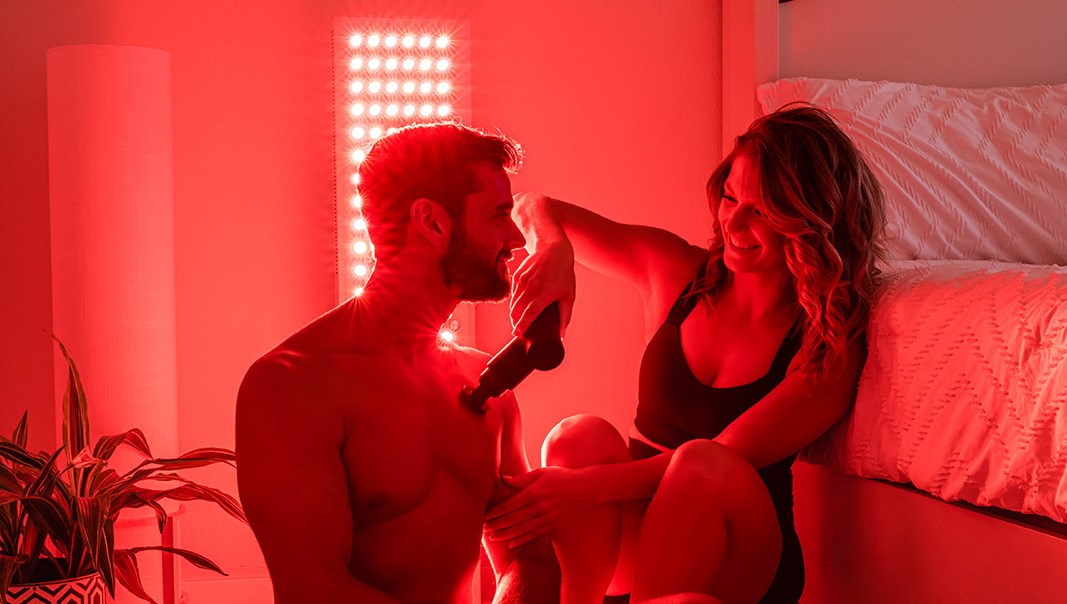
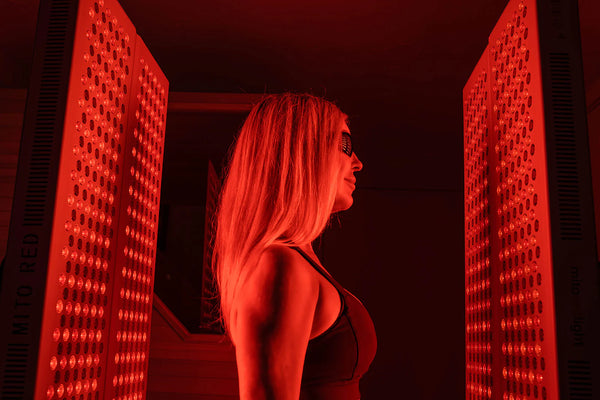
Panels are stationary devices designed to cover a much larger treatment area. You typically stand or sit 6–18 inches away for 10–20 minutes, allowing red and near-infrared light to reach skin, muscles, and joints over broad regions of the body.
Best for: muscle recovery and athletic performance, joint comfort, whole-body energy and sleep, immune and metabolic support, and full-body skin improvements beyond just the face.
Key advantages: high irradiance at treatment distance, the ability to treat large areas at once, flexibility to rotate or reposition to target any region, and deeper penetration into tissues that masks cannot reach. Panels are the go-to choice for users who want systemic photobiomodulation effects rather than only localized cosmetic results.
Limitations: larger size and higher investment compared to most masks, plus the need to stand or sit in front of the panel rather than wearing it while you multitask.
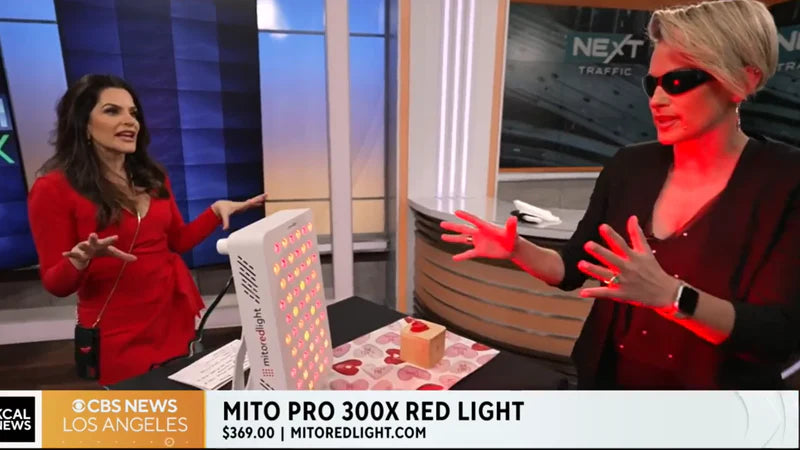
The MitoPRO X is Mito Red Light's flagship full-body panel, and the broader Mito Red Light panel collection ranges from compact personal units to full-body arrays. All Mito panels are independently tested at an ISO/IEC 17025-accredited lab to confirm wavelength accuracy and irradiance — see the independent third-party testing data for the actual measured output across the lineup.
When to Use Each — and How to Stack Them
The mask-vs-panel question often gets framed as either/or. In practice, the two formats solve overlapping but distinct problems — and many people who own both do so on purpose, because each device fits a different slot in a daily routine.
A panel is positioned in a room you already spend time in — an office corner, a bedroom, a home gym — and used in extended sessions where you sit, stretch, recover, or simply work. The treatment is systemic and the device doubles as part of the room's light environment. A mask, by contrast, is a contact device for short, high-intensity sessions targeting the face — typically before bed, while watching TV, or as part of a skincare routine. Different cadence, different goal.
If you only have time and budget for one and your priority is purely cosmetic facial results, a quality LED mask delivers the most efficient face-focused dose. If you want benefits beyond skin — sleep quality, recovery, joint support, sustained energy — a panel does meaningfully more work. People who own both usually run the panel daily for systemic support and add the mask 3–5 times per week for concentrated facial protocols.
Can You Use a Panel on Your Face?
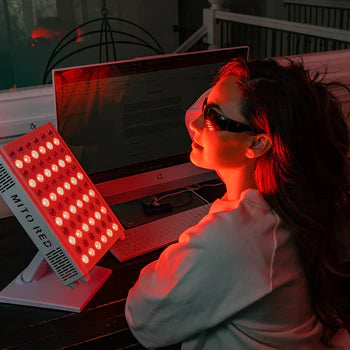
Yes. You can absolutely use a panel for facial red light therapy by positioning your face about 6–12 inches away for 10–20 minutes per session. This is a practical option if you already own a panel and want to support facial skin without adding a mask.
Because distance reduces irradiance, a panel will generally deliver a slightly lower dose to the face than a contact-style LED mask over the same time. Many committed users therefore choose to combine approaches — using a panel for daily full-body and systemic benefits and a dedicated mask like MitoGLOW a few times per week for high-intensity facial protocols.
Cost Comparison
- LED masks: typically around $200–$600 for high-quality devices with verified red and near-infrared wavelengths, and in some cases additional blue and amber LEDs for acne and tone.
- Entry panels: roughly $300–$600 for smaller panels ideal for targeted body regions or as an introduction to panel-based red light therapy.
- Full-body panels and setups: often $700–$2,000+ for large systems designed for comprehensive head-to-toe coverage and higher irradiance.
For a deeper buying-decision walkthrough on the panel side — irradiance benchmarks, build quality, third-party testing — see our red light therapy panel buying guide.
Frequently Asked Questions
Is a red light therapy mask as effective as a panel?
For facial skin goals, a high-quality LED mask can be just as effective — and sometimes more convenient — than using a panel, because it delivers light right against the skin across the entire face at once. For muscles, joints, sleep, and full-body effects, a panel is significantly more capable because it treats much larger areas at higher irradiance.
Can I use a red light panel on my face instead of a mask?
Yes. Position your face 6–12 inches from your Mito Red Light panel for about 10–20 minutes, following the device guidelines. This can meaningfully support facial photobiomodulation, especially when used consistently, though contact delivery from a mask like MitoGLOW will deliver a stronger dose in less time.
Do I need both a mask and a panel?
It depends on your goals. If you only care about facial skin — tone, texture, acne, fine lines — a dedicated LED mask is usually enough. If you want benefits such as muscle recovery, energy, and sleep alongside skin benefits, a panel is the better single-device investment. Many advanced users eventually choose to own both for maximum flexibility.
Which is better for acne — a mask or a panel?
For acne specifically, an LED mask with blue light has a clear advantage because blue wavelengths target Cutibacterium acnes bacteria in the pores. The MitoGLOW mask combines blue, red, and near-infrared light so you can address both bacteria and deeper skin processes in the same session, which standard red/NIR-only panels cannot do.
How long do red light therapy masks last?
Quality LED masks rated for 50,000+ hours can typically provide 10 or more years of regular use. Look for medical-grade LED chips, verified wavelengths, and a strong warranty. Lower-cost devices often use cheaper chips that degrade faster or drift away from their advertised wavelengths over time.
Is the MitoPRO X a full-body panel?
Yes. The MitoPRO X is designed for full-body red light therapy sessions at therapeutic distances. It delivers red and near-infrared wavelengths at independently tested irradiance levels — see third-party test results for the measured output.
References
- Wunsch A, Matuschka K. A controlled trial to determine the efficacy of red and near-infrared light treatment in patient satisfaction, reduction of fine lines, wrinkles, skin roughness, and intradermal collagen density increase. Photomedicine and Laser Surgery. 2014;32(2):93–100. https://pubmed.ncbi.nlm.nih.gov/24286286/
- Papageorgiou P, Katsambas A, Chu A. Phototherapy with blue (415 nm) and red (660 nm) light in the treatment of acne vulgaris. British Journal of Dermatology. 2000;142(5):973–978. https://pubmed.ncbi.nlm.nih.gov/10809858/
- Hamblin MR. Mechanisms and mitochondrial redox signaling in photobiomodulation. Photochemistry and Photobiology. 2018;94(2):199–212. https://pubmed.ncbi.nlm.nih.gov/29164625/
- Hernández-Bule ML, Naharro-Rodríguez J, Bacci S, Fernández-Guarino M. Unlocking the Power of Light on the Skin: A Comprehensive Review on Photobiomodulation. International Journal of Molecular Sciences. 2024;25(8):4483. https://www.mdpi.com/1422-0067/25/8/4483
Mito Red Light products are general wellness devices. They are not medical devices and have not been evaluated, cleared, or approved by the FDA or any regulatory body for the diagnosis, treatment, cure, or prevention of any disease or medical condition. Any references to peer-reviewed research or clinical studies on this page describe findings from independent scientific literature and do not imply that Mito Red Light devices have been studied, tested, or proven effective for any specific condition. Always consult a qualified healthcare provider before beginning any new wellness routine, particularly if you have a medical condition or are taking medication.
Related articles
More from the red light therapy masks knowledge cluster