





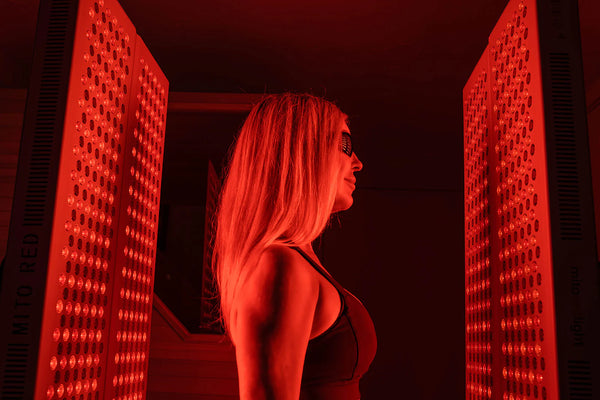
Panel Series
Red light therapy may help improve the appearance of stretch marks by supporting the same skin processes involved in collagen production, tissue remodeling, and dermal repair. Stretch marks, also called striae, are a type of dermal scar that forms when skin stretches faster than the collagen and elastin network can adapt. Red and near-infrared wavelengths cannot erase stretch marks completely, but consistent use may help support smoother-looking skin, improved tone, and gradual visible improvement over time.
Last updated: April 2026
Can Red Light Therapy Help Stretch Marks?
Red light therapy may help support the appearance of stretch marks, but it should not be expected to remove them completely. Stretch marks are a form of scarring in the dermis, the deeper layer of skin where collagen and elastin provide structure. Once that collagen network has been disrupted, improvement usually happens gradually and is more about softening color, texture, and visibility than making the marks disappear.
The reason red light therapy is relevant is that photobiomodulation has been studied for skin rejuvenation, collagen density, wound repair, inflammation signaling, and fibroblast activity. Fibroblasts are the cells that help produce collagen and other structural components of the skin. A 2024 review on photobiomodulation in dermatology describes PBM as a non-invasive approach that can influence cellular functions and biological processes in skin, although results depend heavily on wavelength, dose, treatment frequency, and the condition being addressed.
For stretch marks specifically, the best way to think about red light therapy is as a supportive skin-quality tool. It may help improve the environment for collagen remodeling and healthier-looking skin, but it is not a scar-removal procedure and it is not a substitute for medical dermatology treatments when those are needed.
| Question | Practical answer |
|---|---|
| Can red light therapy erase stretch marks? | No. Stretch marks are dermal scars, so full removal is unlikely. |
| Can it improve their appearance? | Possibly. It may support smoother-looking skin, tone, texture, and collagen-related repair processes. |
| How long does it take? | Most skin-quality routines should be evaluated after at least 8–12 weeks of consistent use. |
| What device type makes sense? | A panel is usually more practical than a mask because stretch marks commonly appear on the abdomen, hips, thighs, glutes, chest, and upper arms. |
What Are Stretch Marks?
Stretch marks, also called striae or striae distensae, are a type of skin scar that forms when the skin stretches quickly. They often appear as red, purple, pink, brown, silver, or white streaks. They commonly develop on the abdomen, hips, thighs, glutes, chest, upper arms, and lower back.
Common causes include:
- Pregnancy
- Rapid weight gain
- Rapid weight loss
- Puberty and growth spurts
- Rapid muscle gain
- Hormonal changes
- Long-term corticosteroid use
- Genetic predisposition
Stretch marks often start darker or more inflamed-looking, then fade over time. Newer stretch marks are usually called striae rubrae, while older, lighter stretch marks are often called striae albae. Older stretch marks can still improve in appearance, but they are typically slower to change because the tissue is more mature and scar-like.
Why Collagen and Elastin Matter
The dermis contains collagen and elastin fibers that help skin stay firm, flexible, and resilient. When skin stretches faster than this support network can adapt, the dermal matrix can become disrupted. The body repairs the area, but the new tissue does not always match the structure, color, or texture of surrounding skin.
This is why stretch marks are difficult to address. They are not just surface discoloration. They involve deeper structural changes in the skin. Topical products may help with hydration and surface appearance, but deeper visible improvement usually requires time and consistent support for the skin’s remodeling processes.
For broader background on red light therapy and skin structure, see our Skin & Anti-Aging Clinical Evidence Hub.
How Red Light Therapy May Support Stretch Mark Appearance
Red light therapy works through photobiomodulation, a process in which specific wavelengths of light interact with cells and influence biological activity. In skin research, red and near-infrared wavelengths have been studied for mitochondrial function, ATP production, fibroblast activity, collagen-related signaling, inflammation modulation, and tissue repair.
For stretch marks, the most relevant potential mechanisms are:
- Collagen support: Red light therapy has been studied for effects on fibroblasts and intradermal collagen density.
- Skin texture support: PBM research has examined improvements in skin roughness, elasticity, and overall appearance.
- Inflammation signaling: Photobiomodulation research has explored anti-inflammatory pathways that may be relevant for newer, redder stretch marks.
- Cellular energy: Red and near-infrared wavelengths are studied for their effects on mitochondrial activity and ATP production.
A controlled trial published in Photomedicine and Laser Surgery found that red and near-infrared light treatment was associated with improvements in skin feeling, skin appearance, skin roughness, and intradermal collagen density. A 2023 review on red light photobiomodulation and skin aging also describes red light absorption as a process that can influence ATP production, cell signaling, growth factor synthesis, and oxidative stress.
This does not prove that red light therapy removes stretch marks. It does support the rationale for using red and near-infrared light as part of a consistent skin-quality routine.
Best Wavelengths for Stretch Marks
For stretch marks, the most relevant wavelengths are the same wavelengths most often discussed for skin rejuvenation and dermal support: red light around 630–660 nm and near-infrared light around 810–850 nm.
| Wavelength range | Type | Why it matters for stretch marks |
|---|---|---|
| 630 nm | Red light | Relevant for surface-level skin tone, redness, and visible skin-quality support. |
| 660 nm | Red light | One of the most studied skin-focused PBM wavelengths; relevant for fibroblast and collagen-related research. |
| 810–830 nm | Near-infrared | Penetrates more deeply than visible red light and may support deeper dermal and connective-tissue targets. |
| 850 nm | Near-infrared | Common in full-body panels and useful when treating larger body areas where stretch marks often appear. |
For a deeper breakdown of wavelength selection, see our Red Light Therapy Wavelengths Hub.
New vs. Old Stretch Marks
Newer stretch marks and older stretch marks may respond differently because they are in different stages of tissue remodeling.
Newer red or purple stretch marks
Newer stretch marks often appear red, pink, purple, or darker than the surrounding skin. These are usually more active and may still involve visible redness or irritation. Red light therapy may be most relevant here because the tissue is still changing, and supporting the skin environment early may help the marks fade more evenly over time.
Older white or silver stretch marks
Older stretch marks are usually lighter, flatter, and more established. They may still improve in texture or visibility, but the change is usually slower. For older stretch marks, consistency is especially important, and expectations should be realistic. Red light therapy may help support skin quality, but it is unlikely to erase mature stretch marks.
How To Use Red Light Therapy for Stretch Marks
Because stretch marks often appear on larger body areas, a panel is usually more practical than a face mask or small handheld device. A panel can treat the abdomen, hips, thighs, glutes, chest, back, or upper arms more evenly.
A simple routine:
- Start with clean, dry skin. Remove heavy lotions, oils, sunscreen, or makeup from the area.
- Position the panel correctly. Follow your device’s recommended treatment distance.
- Treat consistently. Use the device according to its instructions rather than assuming longer sessions are better.
- Track changes monthly. Take photos in the same lighting and from the same angle every 4 weeks.
- Support the skin barrier. Moisturize after sessions if the area feels dry.
When using a red light panel, device output matters. Mito Red Light publishes independent test data so customers can review third-party output measurements and wavelength verification when choosing a device.
How Long Does It Take To See Results?
Stretch mark appearance changes slowly. For skin-focused red light therapy routines, it is reasonable to evaluate progress after 8–12 weeks of consistent use. Some people may notice changes in tone or texture earlier, but deeper remodeling takes time.
Older stretch marks, lighter stretch marks, and stretch marks caused by major skin stretching may take longer to show visible improvement. If you are comparing progress, use consistent photos rather than relying on memory. Lighting can dramatically change how stretch marks appear.
Can You Combine Red Light Therapy With Skincare?
Yes, but the sequence matters. Red light therapy works best on clean skin or with a light-compatible pre-session product. Heavy creams and oils are better saved for after the session because they may interfere with even light exposure.
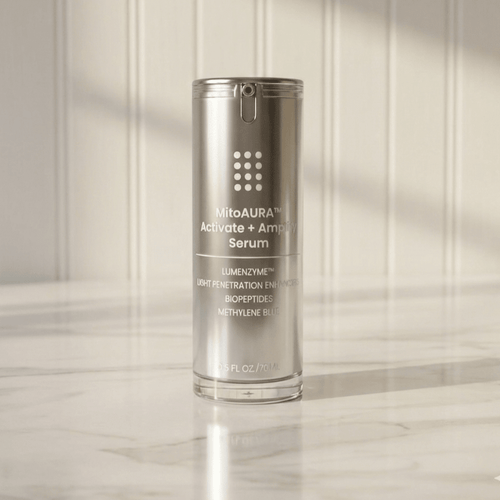
For larger body areas, MitoAURA™ Face & Body Spray may be useful as a lightweight pre-session option. For face, neck, or décolleté skin-quality routines, MitoAURA™ Activate + Amplify Serum is the more targeted choice.
For more detail, read our guide on whether to do skincare before or after red light therapy.
When To Be Careful
Red light therapy is generally well tolerated when used as directed, but some people should speak with a qualified healthcare professional before starting.
- People who are pregnant or recently postpartum
- People with active cancer or a history of cancer in the treatment area
- People with photosensitive conditions
- People taking photosensitizing medications
- People with active skin infections, open wounds, or unexplained rashes
- People recovering from surgery or cosmetic procedures
For a more complete safety overview, read our guide to red light therapy contraindications.
Best Mito Red Light Device Type for Stretch Marks
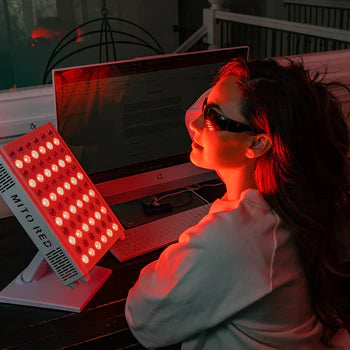
For stretch marks on the body, a panel is usually the most practical device type because it can cover larger areas more efficiently. The MitoPRO panel series is the best starting point for body-focused routines because panels are easier to position over the abdomen, hips, thighs, glutes, chest, and arms.
If the stretch marks are on the face, neck, chest, or décolleté area, a face-focused routine may make sense. For facial skin-quality goals, the MitoGLOW LED Mask is a more targeted option.
Build a stretch mark routine
Panels for body coverage. Skincare for routine support.
For stretch marks on the abdomen, hips, thighs, glutes, chest, or arms, a red light therapy panel is usually the most practical option.
The Bottom Line
Red light therapy is not a stretch mark removal treatment, but it may be a useful tool for supporting the appearance of stretch-marked skin. The strongest rationale comes from research on photobiomodulation, fibroblast activity, collagen-related signaling, skin texture, and tissue repair.
For best results, use a realistic timeline, choose a device that can cover the affected area, follow the recommended protocol, and track progress with consistent photos. For body stretch marks, a panel-based routine with the MitoPRO panel series is the most practical starting point.
Frequently Asked Questions
Can red light therapy remove stretch marks completely?
No. Red light therapy should not be expected to remove stretch marks completely. Stretch marks are a form of dermal scarring, so improvement is usually gradual and may involve changes in tone, texture, redness, or overall visibility rather than full removal.
How does red light therapy help stretch marks?
Red light therapy may support the appearance of stretch marks by influencing cellular energy, fibroblast activity, collagen-related repair processes, and inflammation signaling in the skin. These mechanisms may help support smoother-looking skin over time when used consistently.
How long does red light therapy take to work on stretch marks?
Most people should evaluate skin-focused red light therapy routines after at least 8–12 weeks of consistent use. Older stretch marks may take longer to show visible changes because the tissue is more mature and scar-like.
What wavelength is best for stretch marks?
Red wavelengths around 630–660 nm and near-infrared wavelengths around 810–850 nm are the most relevant for stretch mark routines because they are commonly studied for skin, collagen, fibroblast, and deeper tissue support.
Can you use red light therapy on postpartum stretch marks?
Many people are interested in red light therapy for postpartum skin appearance, but anyone who is pregnant, recently postpartum, breastfeeding, recovering from surgery, or managing a medical condition should consult a qualified healthcare professional before starting a new light therapy routine.
Is red light therapy better for new or old stretch marks?
Newer red or purple stretch marks may be more responsive because the tissue is still actively changing. Older white or silver stretch marks can still improve in appearance, but changes are usually slower and more subtle.
What device should I use for stretch marks?
For body stretch marks, a red light therapy panel is usually the most practical device because it can cover larger areas such as the abdomen, hips, thighs, glutes, chest, and arms. For face, neck, or décolleté skin-quality routines, a face-focused device may be more appropriate.
Can I combine red light therapy with stretch mark creams or oils?
Yes, but timing matters. Use red light therapy on clean skin or with a lightweight, light-compatible pre-session product. Heavy creams and oils are usually better applied after the session because they may interfere with even light exposure.
Mito Red Light products are general wellness devices. They are not medical devices and have not been evaluated, cleared, or approved by the FDA or any regulatory body for the diagnosis, treatment, cure, or prevention of any disease or medical condition. Any references to peer-reviewed research or clinical studies on this page describe findings from independent scientific literature and do not imply that Mito Red Light devices have been studied, tested, or proven effective for any specific condition. Always consult a qualified healthcare provider before beginning any new wellness routine, particularly if you have a medical condition or are taking medication.
Related articles
More from the skin health & anti-aging knowledge cluster