


















Panel Series
For most people, the right order is: cleanse → apply a lightweight pre-session product if desired → red light therapy → moisturizer and targeted skincare afterward. Before a session, the skin should be clean and free of makeup, sunscreen, heavy creams, oils, retinoids, and exfoliating acids. After a session, focus on hydration and barrier support. The pre-session step matters because anything sitting on the skin can affect how consistently light reaches the tissue below.
This article covers the research on why timing matters, which products work before vs. after, what to always skip before a session, and how to build a routine around your device type and skin goal. For the research on what red and near-infrared light actually do in skin, see the skin and anti-aging clinical evidence page or the science of photobiomodulation.
Quick Reference: What to Use Before and After Red Light Therapy
| Product or step | Before session? | After session? | Notes |
|---|---|---|---|
| Clean, dry skin | Yes | — | Best default for every session. Removes barriers to consistent light delivery. |
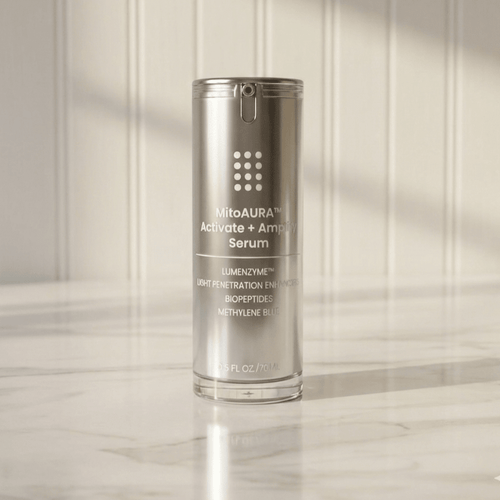
| MitoAURA™ Serum | Yes | Yes | Designed for red light therapy use. Best for face, neck, and décolleté sessions. |
| MitoAURA™ Face & Body Spray | Yes | Yes | Faster application for body panels and larger treatment areas. |
| Lightweight hyaluronic acid or glycerin serum | Usually OK | Yes | Fine if water-based and non-occlusive. Heavier formulations are better saved for after. |
| Peptides or niacinamide | Sometimes | Yes | Lightweight peptide serums can work pre-session; heavier cream formats better post-session. |
| Vitamin C or antioxidant serums | Sometimes | Yes | Some people tolerate it well before; sensitive skin may prefer post-session timing. |
| Ceramide moisturizer or barrier cream | Usually no | Yes | Thicker formulas can create an occlusive layer before a session. Best used after. |
| Retinol, retinoids, AHAs, BHAs | No | Later if tolerated | Increase photosensitivity risk. Keep in a separate routine — ideally separate evening. |
| Sunscreen (mineral or chemical) | No | Yes | Remove before sessions. Apply after morning sessions before daylight exposure. |
| Makeup, foundation, concealer | No | Yes | Always remove before a session. Creates an uneven barrier. |
| Facial oils | No | Yes | Oils can alter light reflection and feel uncomfortable under face masks. |
Why What You Put on Your Skin Before a Session Matters
Red light therapy uses specific wavelengths — primarily 630–680nm in the red range and 810–850nm in the near-infrared range — to interact with biological structures in skin and deeper tissue. The primary mechanism involves absorption by cytochrome c oxidase (CCO) in the mitochondria, which triggers downstream effects on ATP production, nitric oxide release, and cell signaling. But photons can only activate these pathways if they reach the target tissue in the first place. [QUOTABLE]
This is why skin surface conditions matter. A thick occlusive cream can reduce light transmission. A reflective mineral sunscreen is designed to scatter and reflect light — the opposite of what you want before a session. Makeup creates an uneven surface that varies in how much light it absorbs or reflects across different areas of the face. None of these things turn a session to zero, but they introduce inconsistency that compounds over time if you are building a results-focused routine.
What Red Light Actually Does in Skin — and Why Preparation Supports It
The clinical evidence for red light therapy in skin is more specific than most skincare content acknowledges. Barolet's 2009 study in the Journal of Investigative Dermatology — using 660nm LEDs at 50 mW/cm² over 12 sessions — found a 31% increase in type-1 procollagen (the precursor to structural collagen) and an 18% reduction in MMP-1 (the enzyme that breaks down existing collagen) in human skin samples, with more than 90% of participants showing measurable reduction in wrinkle depth and surface roughness.[1] [QUOTABLE]
Barolet's 2023 comprehensive review in Photobiomodulation, Photomedicine, and Laser Surgery mapped the specific cell signaling pathways activated by red and NIR wavelengths in skin keratinocytes and fibroblasts — the cell types responsible for skin structure, barrier function, and collagen production — noting that these pathways depend on photon absorption characteristics that are wavelength- and dose-specific.[2] His 2024 follow-up in Antioxidants further documented differential nitric oxide responses in keratinocytes and fibroblasts across red and NIR wavelengths — with fibroblasts producing 1.5× more NO in response to NIR than red light, reflecting how wavelength specificity extends to cell-type-specific outcomes.[3]
Mota et al. (2023) in a randomized controlled trial in Photobiomodulation, Photomedicine, and Laser Surgery found that red PBM reduced periocular wrinkle volume by 31.6% compared to baseline — one of the most clearly quantified skin outcomes in the recent PBM literature.[4] Kim et al. (2025) in Aesthetic Plastic Surgery found up to 27.22% wrinkle reduction alongside improvements in skin elasticity, moisture, and density using a NIR LED device over 20 weeks.[5]
The takeaway for routine-building: these outcomes come from consistent, protocol-matched sessions where the right wavelengths reach the right tissue at the right dose. Surface preparation is one of the few variables you control at home that directly affects photon delivery. Tripodi et al.'s 2021 systematic review in Journal of Photochemistry and Photobiology B, evaluating PBM effects on human dermal fibroblasts in vitro, confirmed that dose consistency is a key determinant of outcome — reinforcing why removing surface barriers matters.[6]
The Best Products to Use Before Red Light Therapy
Clean, bare skin is always the safe baseline. The next best option is a product specifically formulated to pair with light therapy — lightweight, non-occlusive, and designed with the pre-session step in mind rather than adapted from a conventional skincare routine.
For Face, Neck, and Décolleté Sessions
The MitoAURA™ Activate + Amplify Serum is Mito Red Light's dedicated pre-session product for face-focused routines. It was formulated specifically to complement red light therapy sessions — lightweight enough to avoid interfering with light delivery, and designed with ingredients selected for their photobiology and skin-support properties, including Lumenzyme™ (a light-activated DNA repair enzyme), spirulina extract, and Methylene Blue. It works before a session to prep the skin, and can also be used after as part of the post-session step.
The routine with MitoGLOW or a facial panel:
- Cleanse. Remove all makeup, sunscreen, and heavy skincare residue.
- Apply a thin layer of MitoAURA Serum to face, neck, or décolleté.
- Allow 30–60 seconds to absorb — skin should feel smooth, not slippery or wet.
- Use your MitoGLOW LED Mask or facial red light panel as directed.
- Apply moisturizer, peptides, or other post-session skincare afterward.
For Body Panels and Larger Treatment Areas
The MitoAURA™ Face & Body Spray is the better format for panel sessions covering larger areas — legs, arms, abdomen, back, or full-body protocol areas. A spray applies evenly across large surfaces in seconds without the layering process needed for serum. It contains the same key active ingredients — Lumenzyme™, spirulina, Copper Tripeptide-1, and NMN — in a format optimized for body application.
The routine with a MitoPRO panel:
- Start with clean, dry skin.
- Apply MitoAURA Face & Body Spray over the treatment area.
- Allow 30 seconds to settle.
- Use your MitoPRO X or MitoPRO+ panel as directed for the recommended time and distance.
- Apply body moisturizer afterward if needed.
BioPhotonic Skincare™ for red light therapy
MitoAURA products are formulated specifically for use with red light therapy — not adapted from conventional skincare. Use the Serum for face, neck, and décolleté sessions. Use the Spray for body panels and larger treatment areas. Both work before and after your session.
What to Avoid Before and What to Use After
Skip Before Your Session
- Makeup and foundation
- Mineral or chemical sunscreen
- Heavy moisturizers and face creams
- Facial oils (coconut, rosehip, argan, etc.)
- Retinol and prescription retinoids
- AHAs (glycolic, lactic acid)
- BHAs (salicylic acid)
- Strong peel products
- Self-tanner or bronzer
Use After Your Session
- Ceramide moisturizer
- Hyaluronic acid or glycerin
- Peptides (any weight/format)
- Niacinamide
- Aloe vera, panthenol, centella
- Vitamin C (if tolerated)
- Sunscreen (morning sessions)
- Retinoids (separate routine)
- Targeted actives and treatments
Why Retinoids Specifically Need Their Own Routine
Retinol and prescription retinoids (tretinoin, adapalene) accelerate skin cell turnover and can significantly increase skin sensitivity. Using them immediately before red light therapy — particularly with a face mask or close-proximity device — raises the risk of irritation and photosensitivity. If you use retinoids, keep them in a separate evening routine and allow at least one day between application and your next red light session, or follow your dermatologist's specific guidance. This applies to both OTC retinol and prescription-strength formulations. [QUOTABLE]
Why Sunscreen Comes Off Before a Session
Both mineral and chemical sunscreens are engineered to interact with light — mineral SPF physically reflects and scatters UV (and other wavelengths), while chemical SPF absorbs photons and converts them to heat. Either way, sunscreen placed between your skin and the light source will reduce the amount of red and NIR light reaching the tissue below. Always remove sunscreen with a thorough cleanse before a session. Reapply after morning sessions before heading outdoors.
Routines by Goal and Device Type
Face Anti-Aging
- Cleanse thoroughly
- Apply MitoAURA Serum
- Use MitoGLOW mask as directed
- Apply peptides or ceramide moisturizer
- Sunscreen if morning session
Acne and Clear Skin
- Cleanse — remove all oil and residue
- Bare skin or lightweight water-based serum
- Use blue + red mode on MitoGLOW
- Apply non-comedogenic moisturizer
- Avoid stacking actives post-session
Full-Body Panel Session
- Start with clean, dry skin
- Apply MitoAURA Spray
- Use MitoPRO X or MitoPRO+ as directed
- Apply body moisturizer afterward
Sensitive or Reactive Skin
- Cleanse with gentle, fragrance-free wash
- Red light on bare skin — no products initially
- Apply bland ceramide moisturizer
- Add MitoAURA only once bare-skin tolerance is confirmed
- Patch test any new products first
Notes by Skin Type
Dry skin
Dry skin tolerates lightweight hydration before a session well — a water-based hyaluronic acid serum or MitoAURA Serum is a good fit. Save richer barrier creams for the post-session step, when hydration is better locked in over already-treated skin.
Oily and acne-prone skin
Less is more before a session. Oily skin benefits most from a clean surface, possibly with a gentle toner or lightweight serum like MitoAURA. Heavy pre-session layers can contribute to comedone formation under face masks. For acne-specific goals, Friedmann et al.'s 2026 RCT in Dermatology Surgery found that daily at-home red and blue LED treatment significantly reduced inflammatory and total acne lesions at 4 and 8 weeks.[7] Li et al. (2022) in Photodermatology, Photoimmunology & Photomedicine found comparable efficacy between red and blue light for mild-to-moderate acne, with red light showing fewer adverse reactions than blue — relevant for anyone choosing between modes on a multi-wavelength device.[8]
Combination skin
Treat zones differently if needed: lightweight serum on drier areas, clean skin on oilier areas. Post-session, use a balanced moisturizer that doesn't over-hydrate the T-zone.
Darker skin tones
A 2024 study in Archives of Dermatology Research (de Bona Sartor et al.) found that individuals with darker skin phototypes perceived heat sensations during PBM at lower doses and shorter application times than lighter skin types — suggesting the importance of starting conservatively and building up exposure time gradually rather than immediately matching protocols designed for lighter skin.[note: verify PMID]
Does the Device Type Change the Skincare Approach?
Broadly, no — the pre-session principles are the same regardless of device. But the format of MitoAURA preparation changes based on what you are using.
MitoGLOW LED Mask: Face-specific prep makes the most sense. Cleanse, apply MitoAURA Serum, let it settle, then use the mask. The mask's four wavelengths (465nm blue, 590nm amber, 630nm red, 830nm NIR) each serve different skin goals — see the wavelength reference guide for how to choose modes based on your skin goals.
MitoPRO panel (face use): Same approach as MitoGLOW — serum pre-session, moisturizer post-session.
MitoPRO panel (body use): Switch to MitoAURA Spray for larger coverage areas. The spray applies in one pass across large surfaces where serum would be impractical.
MitoADAPT Series: With eight wavelengths and eleven modes, the MitoADAPT lets you target specific outcomes. The skincare approach follows the same logic: clean skin or MitoAURA prep before, then targeted post-session actives based on what modes you ran.
For all panel-based devices, Mito Red Light publishes independent third-party test data — irradiance at distance, wavelength accuracy, and beam uniformity — so you can confirm device output rather than relying on manufacturer claims alone.
For the full clinical evidence base on skin and anti-aging outcomes from red light therapy, including collagen, texture, and acne research, see the skin and anti-aging clinical evidence page. The research evidence hub covers 15 clinical categories. The full database of over 9,500 peer-reviewed PBM studies is searchable at mitoredlight.com/pages/evidence-explorer.
Frequently Asked Questions
Should I do skincare before or after red light therapy?
Cleanse first, do your red light therapy session, then apply moisturizer and targeted skincare afterward. Before a session, the skin should be free from makeup, sunscreen, heavy creams, oils, retinoids, and exfoliating acids. A lightweight, pre-session product like MitoAURA Serum or MitoAURA Face & Body Spray can be used before the session if desired.
Can I use MitoAURA before red light therapy?
Yes — MitoAURA products are designed for this. Use MitoAURA Serum before face, neck, and décolleté sessions. Use MitoAURA Face & Body Spray before body panel sessions or larger treatment areas. Both can also be used post-session as part of your skincare routine.
Can I use retinol before red light therapy?
No. Retinol and prescription retinoids increase skin photosensitivity and should not be applied immediately before a red light session. Keep retinoids in a separate routine — ideally a different evening — and allow at least one day between application and your next session. If you use prescription retinoids, follow your dermatologist's guidance on timing.
Should I wash my face before red light therapy?
Yes. Washing before a session removes makeup, sunscreen, sweat, oil, and skincare residue that can interfere with consistent light delivery. Pat dry before applying any pre-session product or starting your session.
Can I use vitamin C before red light therapy?
Some people tolerate lightweight vitamin C serums before a session. Sensitive skin may prefer post-session timing, as vitamin C can sting on skin that is slightly warm post-treatment. Start post-session if you are unsure, and patch test before adding it to the pre-session step.
What should I put on after red light therapy?
After red light therapy, focus on hydration and barrier support: ceramide moisturizer, hyaluronic acid, peptides, niacinamide, aloe, or panthenol are all good choices. Apply sunscreen after morning sessions before outdoor exposure. Stronger actives like retinoids are better saved for a separate evening routine.
Does red light therapy make skincare absorb better?
This is sometimes claimed but the mechanism is not well established in the human clinical literature. What is established is that red light activates fibroblast activity, collagen pathways, and nitric oxide release in skin tissue.[1] Whether post-session skin is more receptive to topical ingredients than pre-session skin is an interesting question, but not yet a confirmed mechanism. The more reliable reason to apply skincare after a session is timing convenience and the avoidance of pre-session barriers — not a documented "enhanced absorption" effect.
Is the skincare routine different for MitoGLOW vs. a panel?
The principles are the same. For MitoGLOW, use MitoAURA Serum before the session and moisturizer afterward. For a body panel, use MitoAURA Face & Body Spray before the session. The main difference is format: serum for face-focused sessions, spray for body sessions.
References
- Barolet D, et al. (2009). Regulation of skin collagen metabolism in vitro using a pulsed 660 nm LED light source: clinical correlation with a single-blinded study. Journal of Investigative Dermatology. PubMed
- Barolet D, et al. (2023). Low-Intensity Visible and Near-Infrared Light-Induced Cell Signaling Pathways in the Skin: A Comprehensive Review. Photobiomodulation, Photomedicine, and Laser Surgery. PubMed
- Barolet D, et al. (2024). Differential Nitric Oxide Responses in Primary Cultured Keratinocytes and Fibroblasts to Visible and Near-Infrared Light. Antioxidants. PubMed
- Mota LR, et al. (2023). Photobiomodulation Reduces Periocular Wrinkle Volume by 30%: A Randomized Controlled Trial. Photobiomodulation, Photomedicine, and Laser Surgery. PubMed
- Kim JH, et al. (2025). Clinical Application of a New Near-Infrared Light-Emitting Diode with Broader Spectrum for Skin Rejuvenation and Hair Growth Enhancement. Aesthetic Plastic Surgery. PubMed
- Tripodi N, et al. (2021). The effects of photobiomodulation on human dermal fibroblasts in vitro: A systematic review. Journal of Photochemistry and Photobiology B. PubMed
- Friedmann DP, et al. (2026). Comparing a Red and Blue Light-Emitting Diode Light Device With an Existing Blue Light Device for At-Home Treatment of Inflammatory Acne. Dermatologic Surgery. PubMed
- Li X, et al. (2022). Comparison of red light and blue light therapies for mild-to-moderate acne vulgaris: A randomized controlled clinical study. Photodermatology, Photoimmunology & Photomedicine. PubMed
This article was reviewed for scientific accuracy by Dr. Alexis Cowan, PhD in Molecular Biology (Princeton University), who specializes in mitochondrial function and photobiomodulation research. Last updated: May 2026.
This article discusses published scientific research and general educational information about photobiomodulation and red light therapy. It does not constitute medical advice and does not make specific claims about Mito Red Light devices. The research cited reflects independent peer-reviewed studies and does not imply that any Mito Red Light product has been evaluated, approved, or cleared by the FDA or any other regulatory body for the diagnosis, treatment, cure, or prevention of any disease or medical condition. Individual results vary. Consult a qualified healthcare professional before beginning any light therapy protocol, particularly if you have a pre-existing medical condition, are pregnant, or are taking photosensitising medications.
Mito Red Light products are general wellness devices. They are not medical devices and have not been evaluated, cleared, or approved by the FDA or any regulatory body for the diagnosis, treatment, cure, or prevention of any disease or medical condition. Any references to peer-reviewed research or clinical studies on this page describe findings from independent scientific literature and do not imply that Mito Red Light devices have been studied, tested, or proven effective for any specific condition. Always consult a qualified healthcare provider before beginning any new wellness routine, particularly if you have a medical condition or are taking medication.
Related articles
More from the skin health & anti-aging knowledge cluster