





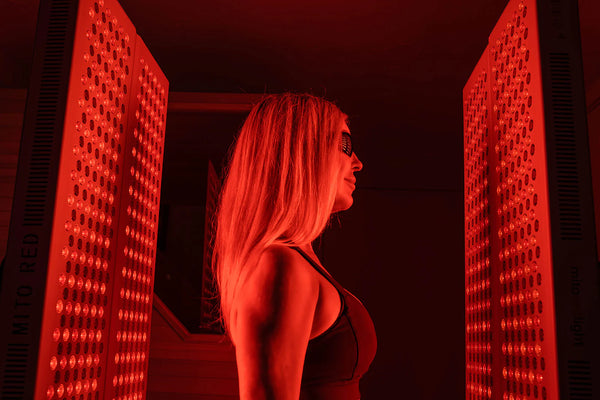
Panel Series
Red light therapy wavelengths between 630 and 850 nm are the most common ranges used for photobiomodulation because they can interact with cellular light receptors while penetrating tissue at useful depths. In general, 630-660 nm visible red light is used for skin-level goals such as tone, texture, acne support, and collagen signaling, while 810-850 nm near-infrared light reaches deeper tissue such as muscle, joints, and connective tissue. The “best” wavelength depends on the goal: 660 nm is commonly used for collagen and skin rejuvenation, 630 nm is often paired with blue light for acne protocols, 810 nm is heavily studied in brain and nerve-related photobiomodulation research, and 850 nm is widely used for recovery and joint-support applications.
Last updated: April 2026. Reviewed for wavelength research, device-selection guidance, and internal links to Mito Red Light evidence resources.
What Is a Wavelength in Red Light Therapy?
In red light therapy, wavelength refers to the distance between successive peaks of a light wave, measured in nanometers (nm). This single number helps determine two things that matter for outcomes: how deeply the light can penetrate into tissue, and which biological molecules — called chromophores — it may interact with.
One of the most discussed chromophores in red and near-infrared light therapy is cytochrome c oxidase (CCO), an enzyme in the mitochondrial respiratory chain. CCO appears to absorb light within parts of the red and near-infrared spectrum, which may help explain why these wavelengths are so frequently studied in photobiomodulation research. When appropriate wavelengths reach target tissue at an appropriate dose, studies suggest they may influence mitochondrial signaling, ATP production, oxidative stress, nitric oxide availability, and downstream repair processes.
Wavelengths outside the commonly discussed photobiomodulation window can still have biological effects, but they do not behave the same way. UV light carries DNA-damage risk, while far-infrared is primarily associated with heat-based effects rather than the same red/NIR photochemical pathways. The wavelengths in this guide are emphasized because they are among the most studied ranges for red light therapy and near-infrared photobiomodulation.
The Therapeutic Window: 600-1000 nm
The therapeutic window for photobiomodulation sits approximately between 600 nm and 1000 nm. Within this range, light can penetrate living tissue without being completely absorbed by water, melanin, or hemoglobin before reaching the intended target tissue.
Within this window, two sub-ranges stand out in the research literature:
- Red light: 630-700 nm — visible red light, primarily used for skin-level and dermal applications
- Near-infrared light: 780-1000 nm — invisible or nearly invisible light, generally used for deeper tissue applications
The most studied and commercially relevant wavelengths within these ranges are 630 nm, 660 nm, 810 nm, 830 nm, and 850 nm. Each has a distinct evidence base, tissue target, and clinical application profile.
2026 Research Update: What Newer Wavelength Studies Reinforce
Recent photobiomodulation research continues to support the idea that wavelength, dose, tissue target, and treatment protocol matter more than simply adding more LEDs or more colors. A 2024 dermatology review describes photobiomodulation as a light-based approach that can modulate cellular functions and biological processes, while emphasizing that treatment parameters vary across skin applications (2024 dermatology photobiomodulation review).
For deeper near-infrared applications, newer studies continue to examine 810 nm and combined red/NIR protocols. One 2024 comparative study found that both 810 nm alone and 810 nm + 660 nm photobiomodulation influenced cytochrome c oxidase activity in multiple brain regions in an animal model (2024 810 nm and 660 nm photobiomodulation study). This does not mean every consumer device produces the same outcome, but it reinforces why 660 nm and 810 nm remain important research wavelengths.
Skin-focused LED mask research is also expanding. A 2025 randomized, sham-controlled study using 630 nm LED and 850 nm infrared-emitting diodes reported improvement in crow’s-feet wrinkle scores over 16 weeks compared with sham treatment (2025 LED/IRED mask study). Another facial rejuvenation study examined a combination of 633, 830, and 1072 nm wavelengths, showing why newer mask brands increasingly discuss longer NIR wavelengths such as 1072 nm (633, 830, and 1072 nm LED face mask study).
The practical takeaway: 630-660 nm and 810-850 nm remain the core evidence-backed red and near-infrared ranges for most at-home red light therapy devices. Emerging wavelengths like 940 nm and 1072 nm may have targeted uses, but they should be evaluated alongside dose, treatment distance, irradiance, coverage, and the quality of the device’s optical testing.
Wavelength Comparison Table
The table below summarizes the most common red and near-infrared wavelengths used in at-home red light therapy devices. Penetration depth is approximate and depends on tissue type, skin tone, contact distance, optical power, beam angle, and treatment dose.
| Wavelength | Type | Best fit | Approx. target depth | Evidence notes | Mito resource |
|---|---|---|---|---|---|
| 465 nm | Blue | Mild to moderate acne-support routines | Surface-level skin | Often studied for acne because blue light can target porphyrins in C. acnes. | MitoGLOW mask |
| 630 nm | Red | Skin tone, surface texture, acne-support protocols | Epidermis and upper dermis | Common in skin-focused LED devices and acne protocols when paired with blue light. | Skin evidence page |
| 660 nm | Red | Collagen support, fine lines, skin rejuvenation, surface recovery | Dermis | One of the most common red-light wavelengths in photobiomodulation research. | Wavelength hub |
| 810 nm | Near-infrared | Brain, nerve, muscle, and deeper tissue research | Deeper soft tissue | Frequently studied in transcranial and neurological photobiomodulation research. | Research Evidence Hub |
| 830 nm | Near-infrared | Deeper dermal support, skin rejuvenation, connective tissue | Deeper dermis and soft tissue | Often paired with 630-660 nm in skin-focused LED protocols. | MitoGLOW mask |
| 850 nm | Near-infrared | Muscle recovery, joint support, full-body panel sessions | Deep soft tissue and joints | A core NIR wavelength in many recovery and panel-based protocols. | MitoPRO panels |
| 940-1072 nm | Longer near-infrared | Emerging or supplementary uses | Variable; protocol-dependent | Interesting emerging range, but less established than 660, 810, 830, and 850 nm for most consumer PBM goals. | Compare wavelengths |
630 nm — Surface Skin and Acne-Support Routines
At 630 nm, light sits at the shorter end of the red spectrum and is generally used for skin-level applications. Because it concentrates more energy near the surface compared with deeper NIR wavelengths, it is commonly used in face-focused LED devices and acne-support protocols.
The primary applications for 630 nm include mild to moderate acne-support routines, surface-level skin texture, tone, and visible redness. Blue light in the 415-465 nm range is typically the primary antimicrobial wavelength used in acne-focused LED protocols because it interacts with porphyrins in Cutibacterium acnes bacteria. Red light is frequently paired with blue light to support skin recovery and visible post-breakout redness.
A randomized controlled study comparing combined 415 nm + 630 nm light therapy against 5% benzoyl peroxide for acne found reductions in inflammatory lesions, with the light therapy group showing fewer reported side effects. The MitoGLOW LED mask uses 630 nm red light and also includes a blue-light mode for acne-support routines.
660 nm — The Collagen Wavelength
660 nm is one of the most extensively used wavelengths in photobiomodulation research for skin, collagen support, and surface-level recovery. It penetrates into the dermis, where fibroblasts reside and where collagen and elastin are synthesized.
At this depth, 660 nm light has been studied for fibroblast activity, collagen signaling, skin elasticity, and visible signs of skin aging. A randomized controlled trial in Photomedicine and Laser Surgery found improvements in skin complexion, collagen density, and skin texture after red light therapy treatment.
For consumers focused on fine lines, firmness, and overall skin quality, 660 nm is one of the most directly relevant wavelengths to understand. For a broader evidence review, see the Mito Red Light skin and anti-aging clinical evidence page.
810 nm — The Neurological and Deep Muscle Wavelength
810 nm sits at an important point in the near-infrared spectrum. It is deep enough to be studied for muscle, nerve, and brain-related applications, and it has a particularly strong evidence base in transcranial photobiomodulation research.
Research on transcranial photobiomodulation — applying near-infrared light near the scalp to study brain-related effects — has concentrated heavily on 810 nm. Studies have examined 810 nm in areas such as traumatic brain injury research, cognitive-function research, and mood-related research. A review in Frontiers in Systems Neuroscience summarized early findings suggesting that transcranial NIR photobiomodulation may influence attention, memory, and executive function in research settings.
For muscle and joint applications, 810 nm is also frequently discussed, though it is often paired with other red or near-infrared wavelengths to cover a wider tissue-depth range. For broader science context, explore the Mito Red Light Research Evidence Hub.
830 nm — Versatile Mid-NIR
830 nm occupies a useful middle ground: it penetrates deeper than visible red light but is still frequently used in skin-focused LED protocols. This makes it a versatile wavelength for deeper dermal support, connective tissue, and broader near-infrared coverage.
At the skin level, 830 nm has been studied in combination with red light for visible skin rejuvenation outcomes. A study published in Seminars in Cutaneous Medicine and Surgery examining combined 633 nm and 830 nm treatment reported improvements in skin roughness, tone, and elasticity.
Devices that include 830 nm alongside red light — such as the MitoGLOW LED mask — are designed to pair surface-level red light with deeper near-infrared support for face-focused routines.
850 nm — Deep Tissue Recovery and Joint-Support Applications
850 nm is one of the most common near-infrared wavelengths used in red light therapy panels. Because near-infrared light reaches deeper tissue than visible red light, 850 nm is widely used in panel-based routines focused on muscle recovery, joint comfort, and body-wide wellness protocols.
The evidence base for near-infrared light in recovery is substantial, though study protocols vary. A systematic review in Lasers in Medical Science found that photobiomodulation applied before and after high-intensity exercise was associated with reduced muscle fatigue and delayed-onset muscle soreness compared with controls.
850 nm is included in many consumer red light therapy panels because it complements 660 nm red light. Red light is generally used for skin-level targets, while 850 nm near-infrared light supports deeper tissue exposure. For panel-based device comparisons, review Mito Red Light’s independent test data to evaluate output transparency, irradiance, and wavelength reporting.
Is 660 nm or 630 nm Better for Skin?
This is one of the most common wavelength questions, and the answer depends on the skin goal. For surface-level concerns such as acne-support routines, redness, and visible texture, 630 nm can be useful because it concentrates more energy near the upper skin layers.
For anti-aging goals that involve collagen support, firmness, and elasticity, 660 nm is often the more relevant red-light wavelength because it reaches deeper into the dermis. In practice, many quality skin-focused devices include both wavelengths or pair red light with near-infrared light to cover multiple skin depths.
What About 940 nm and 1072 nm?
940 nm and 1072 nm are longer near-infrared wavelengths that sometimes appear in newer devices, especially LED masks and specialty NIR products. They are worth watching, but they should not be treated as automatic upgrades over the better-established 660, 810, 830, and 850 nm wavelengths.
For example, 1072 nm has appeared in facial LED mask research alongside 633 nm and 830 nm, and some brands now promote it as a differentiating wavelength. However, the practical value of any longer NIR wavelength still depends on dose, coverage, optical output, treatment distance, tissue target, and whether the device has credible testing behind its wavelength and irradiance claims.
For most at-home users, the core question is not “How many wavelengths does this device have?” but “Does this device deliver the right wavelengths, at the right dose, to the right tissue target?” For panel-based devices, review independent test data so you can evaluate output transparency instead of relying on marketing claims alone.
Does More Wavelengths Mean Better Results?
Not automatically. The value of adding wavelengths depends on whether each additional wavelength addresses a distinct tissue target or biological mechanism. Adding another wavelength that mostly overlaps with an existing one can add complexity without creating a meaningful benefit for the user.
The devices with the strongest practical logic tend to use deliberate combinations of red and near-infrared wavelengths — typically one or two in the red range and one or two in the NIR range — rather than advertising many wavelengths without clearly explaining the role of each one.
For a deeper breakdown, read: Does Adding More Wavelengths to a Red Light Therapy Device Make It Better?
Matching Wavelengths to Your Goals
| Goal | Primary wavelength(s) | Secondary wavelength(s) | Recommended device type |
|---|---|---|---|
| Skin anti-aging, collagen, firmness | 660 nm | 630 nm, 830 nm | LED face mask or facial panel |
| Acne-support routines | 465 nm blue + 630 nm red | 660 nm | Multi-wavelength LED face mask |
| Muscle recovery | 850 nm | 660 nm, 810 nm | Full-body or half-body panel |
| Joint-support routines | 850 nm | 810 nm, 660 nm | Panel or targeted device |
| Brain and nerve-related research | 810 nm | 660 nm, 850 nm | Head-targeted or research-specific device |
| Sleep and evening light routines | 630-660 nm red light | 850 nm | Panel or face mask without blue light mode active |
| Hair growth research | 630-650 nm | 660 nm | Scalp-targeted device or helmet |
Choose by wavelength and use case
Mito Red Light devices are built around evidence-backed red and near-infrared ranges
For face-focused skin goals, compare MitoGLOW’s blue, amber, red, and near-infrared modes. For body-wide recovery or wellness protocols, compare MitoPRO panel options and review independent lab output data before choosing a size.
Frequently Asked Questions
What is the best wavelength for red light therapy?
There is no single best wavelength for every goal. For skin rejuvenation and collagen support, 660 nm is one of the most commonly studied red-light wavelengths. For acne-focused routines, 630 nm is often paired with blue light. For muscle recovery and joint-support goals, 850 nm is widely used because near-infrared light reaches deeper tissue. For brain and nerve-related photobiomodulation research, 810 nm is one of the most studied wavelengths.
What is the difference between 660 nm and 850 nm?
660 nm is visible red light and is mainly used for skin-level targets such as collagen support, tone, texture, and surface recovery. 850 nm is near-infrared light and is used for deeper tissue targets such as muscle, joints, and connective tissue. Many panels combine 660 nm and 850 nm because they target different tissue depths in the same session.
Is 630 nm or 660 nm better for skin?
For surface-level concerns such as acne-support routines, redness, and texture, 630 nm can be useful. For collagen and firmness goals in the dermis, 660 nm is often the more relevant red-light wavelength. Many skin-focused devices use both because they cover slightly different depths and use cases.
What wavelength is near-infrared light?
Near-infrared light generally begins around 780 nm and extends beyond 1000 nm. In red light therapy devices, the most common near-infrared wavelengths are 810 nm, 830 nm, and 850 nm. Unlike visible red light, near-infrared light is usually invisible to the eye and can reach deeper tissue.
Does 940 nm or 1072 nm matter?
940 nm and 1072 nm are longer near-infrared wavelengths that may have targeted or emerging uses, but they have a thinner consumer photobiomodulation evidence base than 660, 810, 830, and 850 nm. They should be evaluated in context: dose, irradiance, coverage, treatment distance, and device testing matter more than simply adding another wavelength.
Can you use red and near-infrared light together?
Yes. Combining red and near-infrared light is common because the wavelengths reach different tissue depths. Red light is generally used for skin-level goals, while near-infrared light is used for deeper tissue. This is why many full-body panels combine red and near-infrared wavelengths in one session.
What wavelengths does MitoGLOW use?
The MitoGLOW LED mask uses 465 nm blue, 590 nm amber, 630 nm red, and 830 nm near-infrared light. These modes are designed for different face-focused goals, including acne-support routines, redness and tone, anti-aging routines, and deeper dermal support.
How do I verify a red light therapy device’s wavelengths?
Look for transparent wavelength information, credible product specifications, and independent testing where available. For panel-based devices, Mito Red Light publishes independent test data so customers can evaluate output transparency instead of relying only on marketing claims.
Mito Red Light products are general wellness devices. They are not medical devices and have not been evaluated, cleared, or approved by the FDA or any regulatory body for the diagnosis, treatment, cure, or prevention of any disease or medical condition. Any references to peer-reviewed research or clinical studies on this page describe findings from independent scientific literature and do not imply that Mito Red Light devices have been studied, tested, or proven effective for any specific condition. Always consult a qualified healthcare provider before beginning any new wellness routine, particularly if you have a medical condition or are taking medication.
Related articles
More from the wavelengths & science knowledge cluster