





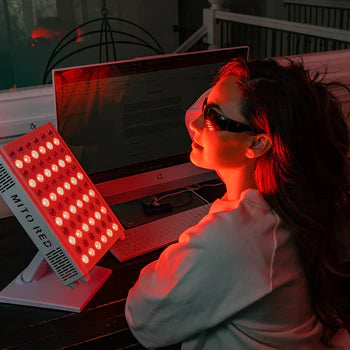



Panel Series
Red light therapy (630–680nm) and near-infrared (NIR) light therapy (810–850nm) work through the same core cellular mechanism — activating cytochrome c oxidase in the mitochondria — but at different tissue depths. Red light primarily reaches skin and surface tissue. Near-infrared light penetrates deeper into muscle, connective tissue, and joints. Most clinical panels combine both wavelength ranges to cover the full depth spectrum in a single session.
If you're new to red and near-infrared light and want the foundational overview first, start with an introduction to red light therapy. This article is focused entirely on the comparison: what makes red and NIR different, what the research shows for each, and how to decide which wavelength range — or which combination — fits your goals.
Red vs. Near-Infrared Light: Key Differences at a Glance
| Feature | Red Light (630–680nm) | Near-Infrared Light (810–850nm) |
|---|---|---|
| Visible to the eye? | Yes — emits a visible red glow | No — invisible even when LEDs are fully active |
| Primary tissue target | Epidermis, dermis, superficial soft tissue | Muscle, fascia, connective tissue, joints, deeper structures |
| Penetration depth | Absorbed primarily in skin layers; depth varies by wavelength and tissue type[2] | Deeper than red light; reaches subcutaneous tissue and muscle under appropriate dosing[2] |
| Core mechanism | CCO activation → ATP ↑, nitric oxide release, ROS modulation at surface depth[6] | Same CCO pathway activated at greater depth; mitochondrial redox signaling in deeper tissue[1] |
| Common wavelengths | 630nm, 633nm, 660nm, 670nm | 808nm, 810nm, 830nm, 850nm |
| Primary clinical applications | Skin rejuvenation, fine lines, collagen support, acne, surface wound healing | Muscle recovery, joint support, full-body protocols, deeper tissue applications |
| Clinical evidence strength | Extensive human RCTs in dermatology; collagen, wrinkle, and wound outcomes[3] | Extensive meta-analyses in musculoskeletal recovery; in-vivo CCO activation confirmed[1][7] |
How Red Light Works — Mechanism and Clinical Evidence
Red light, in the context of photobiomodulation (PBM), refers to visible wavelengths between 630 and 680nm. Among these, 660nm is the most extensively studied single wavelength in the PBM literature — appearing across hundreds of human studies in categories from dermatology to wound healing to pain management. These wavelengths are absorbed primarily in the epidermis and upper dermis, which is why red light is the preferred range for any goal where the target tissue is near the skin surface. [QUOTABLE]
The mechanism is well established. Red light photons are absorbed by cytochrome c oxidase (CCO — the terminal enzyme of the mitochondrial electron transport chain and the primary photoacceptor for red and NIR wavelengths), triggering increased ATP production, nitric oxide (NO) release from its inhibitory binding to CCO, and modulation of reactive oxygen species (ROS). A 2020 review by Quirk and Whelan in Photobiomodulation, Photomedicine, and Laser Surgery — one of the most cited mechanistic reviews in the field — identified CCO activation and nitric oxide release as the central events driving PBM effects across the red and NIR spectrum.[6]
The clinical evidence for red light at skin level is well-documented. A 2023 randomized controlled trial by Mota et al., published in Photobiomodulation, Photomedicine, and Laser Surgery, found that red PBM reduced periocular wrinkle volume by 31.6% compared to baseline, with quality-of-life improvements also reported — a quantified skin outcome directly attributable to surface-level photobiomodulation.[3] Barolet's 2023 comprehensive review in the same journal documented the cell signaling pathways activated by red and NIR light in skin keratinocytes and fibroblasts — the two cell types most relevant to skin structure, collagen production, and aging — noting wavelength-specific response profiles that explain why red wavelengths are particularly effective for skin-focused goals.[5]
For the full clinical evidence base on red light and skin outcomes, see Mito Red Light's skin and anti-aging clinical evidence page.
How Near-Infrared Light Works — Mechanism and Clinical Evidence
Near-infrared light at 810–850nm occupies the portion of the electromagnetic spectrum just beyond what the human eye can detect. Despite being invisible, NIR photons carry sufficient energy to penetrate past the skin surface and reach deeper tissue structures — muscle, fascia, connective tissue, and joint capsules — where they activate the same core CCO pathway as red light but in cells that red wavelengths cannot reach in meaningful quantities. [QUOTABLE]
The most direct in-vivo confirmation of NIR's mechanism comes from Pruitt et al. (2022), published in Metabolites. Using broadband near-infrared spectroscopy, this human study measured real-time concentrations of oxidized cytochrome c oxidase (oxCCO — a direct, non-invasive biomarker of CCO activation) and hemoglobin oxygenation in living human forearm tissue during and after PBM at multiple wavelengths. An 810nm LED at approximately 135 mW/cm² produced statistically significant increases in both oxCCO and tissue oxygenation compared to sham — providing direct in-vivo evidence that NIR wavelengths activate the mitochondrial electron transport chain in living human tissue, not just in isolated cell models.[1] [QUOTABLE]
For musculoskeletal and recovery applications, the evidence base is substantial. A 2016 RCT by Vanin et al. in Photomedicine and Laser Surgery found that pre-exercise 810nm PBM at 50J significantly improved skeletal muscle performance biomarkers and reduced muscle damage markers compared to placebo in healthy adults — one of several human RCTs establishing the dose-response relationship for NIR in exercise contexts.[9] Álvarez-Martínez and Borden's 2025 systematic review in Lasers in Medical Science, evaluating whole-body PBM protocols for exercise performance and recovery, further consolidated the evidence base for NIR-dominant protocols in physical performance contexts.[7] And Vanin et al.'s meta-analysis in Lasers in Medical Science — pooling data from multiple RCTs on healthy exercising adults — found consistent improvements in muscular performance and reductions in fatigue-related markers following PBM across studies.[8]
NIR's reach also extends to skin — though differently than red light. A 2025 human study by Kim et al. in Aesthetic Plastic Surgery using a broader-spectrum NIR LED device found wrinkles decreased by up to 27.22% alongside improvements in skin texture, elasticity, moisture, and density — demonstrating that NIR wavelengths produce skin benefits through deeper dermal interactions, particularly in fibroblast-rich tissue below the epidermis.[4]
For the full clinical evidence on PBM and muscle recovery, see the muscle recovery and performance clinical evidence page. For joint and orthopedic outcomes, see the joints and orthopedics clinical evidence page.
"Wavelength isn't a marketing preference — it's a photochemistry decision that determines which tissue you're actually reaching. Cytochrome c oxidase has absorption peaks around 660nm in the red range and around 810–830nm in the near-infrared. When you apply red light, you're activating CCO in the tissue layers where those photons are absorbed — primarily skin and superficial soft tissue. When you shift to NIR, the longer wavelengths travel deeper before being absorbed, engaging the same mitochondrial pathway but in muscle and connective tissue. That depth difference isn't subtle. It determines the clinical outcome."— Dr. Alexis Cowan, PhD, Molecular Biology (Princeton University), Scientific Advisor, Mito Red Light
The Three Differences That Matter Most
1. Visibility
Red light in the 630–680nm range is visible — it produces the characteristic red glow you see when a panel is active. Near-infrared light at 810–850nm sits just beyond the visual range of the human eye, making it invisible even when LEDs are emitting at full power. A device running NIR only will appear dim or nearly dark while fully operational. This surprises many new users who assume a dim panel is underperforming — it is not.
2. Penetration Depth — The Critical Distinction
Penetration depth is the most clinically important difference between red and NIR. Finlayson's 2022 study in Photochemistry and Photobiology — the most rigorous modern wavelength-penetration dataset available — confirmed that light penetration into skin increases systematically with wavelength across the 200–1000nm range, consistent with the optical scattering and absorption properties of biological tissue.[2] In practical terms: red wavelengths are absorbed in the epidermis and dermis; NIR wavelengths travel further, reaching subcutaneous tissue, muscle, and deeper structures. The same CCO activation pathway produces different clinical outcomes based on where in the body those photons are absorbed. [QUOTABLE]
3. Target Tissue and Application
Red light is the wavelength range of choice when the goal involves tissue at or near the skin surface. Near-infrared is the choice when the goal involves tissue below the skin — muscle, joints, connective tissue, or any deeper structure. Most conditions and wellness goals don't fit neatly into one category, which is why real-world clinical protocols almost always combine both.
When to Use Red, NIR, or Both
Red Light Only
- Skin appearance and texture
- Fine lines and wrinkles
- Collagen-supportive routines
- Acne and surface inflammation
- Face masks (630nm, 660nm)
- Surface wound healing
Near-Infrared Only
- Muscle recovery post-exercise
- Joint comfort and support
- Deep tissue applications
- Larger muscle groups
- Full-body recovery protocols
- Deeper soft tissue goals
Red + NIR Combined
- General wellness routines
- Comprehensive recovery
- Skin + muscle simultaneously
- Full-body panel sessions
- Most at-home protocols
- Mirroring clinical RCT protocols
For most people doing at-home red light therapy, combined red and NIR is the most practical default. It delivers surface-to-depth coverage in one session and mirrors the dual-wavelength design used in the majority of human clinical trials on photobiomodulation outcomes. The question is rarely "red or NIR" — it is usually "which combination and which protocol."
Why Clinical Protocols Combine Red and NIR — and Why Your Panel Should Too
The dominance of dual-wavelength protocols in the PBM clinical literature is not incidental. Red and NIR wavelengths activate the same core biological mechanism at different tissue depths, meaning they perform complementary functions rather than redundant ones. Red photons reaching the skin surface drive dermal outcomes — collagen, texture, surface repair. NIR photons that pass through skin engage mitochondria in muscle and connective tissue below — recovery, joint support, deeper inflammation modulation. Neither range substitutes for the other; they address different tissue layers in the same session.
Frankowski's 2025 review in Geroscience — among the most comprehensive recent assessments of PBM mechanism and application — described the red-to-NIR therapeutic window as a depth-dependent system, with wavelength selection being a primary protocol design variable rather than a secondary specification.[10] Heiskanen's 2020 review in Ageing Research Reviews further framed red and NIR wavelengths as the biologically relevant portion of the solar spectrum that modern indoor environments systematically deprive humans of — making combined red + NIR therapy a restoration of natural photonic input rather than a pharmaceutical intervention.
Mito Red Light's panels are built on this dual-wavelength logic. The MitoPRO X delivers 590nm, 630nm, 660nm, 810nm, 830nm, and 850nm — the wavelength combination used across the broadest range of human photobiomodulation research. The MitoPRO+ uses 630nm, 660nm, 830nm, and 850nm at clinical irradiance levels. Both deliver the wavelength combinations that appear most consistently in human RCTs and systematic reviews — spec-first design, not marketing-first. [VERIFY PRODUCT URLS]
For wavelength-specific dosing parameters, irradiance thresholds, and protocol guidance based on the clinical literature, see wavelength-specific dosing and penetration depth data.
For the full mechanistic picture — CCO activation, ATP cascade, NO release, and secondary messenger signaling — see how red and near-infrared light trigger cellular response.
For the peer-reviewed clinical evidence base organized by health category, Mito Red Light's research evidence hub provides one of the most comprehensive publicly available PBM research indexes online. The underlying database of over 9,500 peer-reviewed studies is searchable at mitoredlight.com/pages/evidence-explorer.
Frequently Asked Questions
Is red light better than near-infrared light?
Neither is universally better — the right wavelength range depends on your target tissue. Red light (630–680nm) is better suited to skin and superficial tissue because those wavelengths are absorbed at surface depth, where dermal cells and capillaries sit. Near-infrared (810–850nm) is better suited to muscle, joints, and deeper tissue because longer wavelengths travel further before being absorbed. Most clinical panels combine both to address the full depth range in one session.
Can I use red and near-infrared light at the same time?
Yes — and most human RCTs on photobiomodulation use exactly this approach. Combining red and NIR in a single session allows surface-level and deep-tissue photobiomodulation simultaneously. The wavelengths don't interfere with each other; they activate CCO at different tissue depths. This is why dual-wavelength panels are the standard format in both research protocols and well-designed at-home devices.
Why can't I see near-infrared light on my panel?
Near-infrared at 810–850nm sits just beyond the range of human vision (~380–700nm), so the LEDs are invisible even at full power. A device running NIR only will appear dim or nearly dark while still delivering full therapeutic irradiance. If your panel has separate red and NIR modes, the visible glow will dim or disappear when switching to NIR — that is normal and expected.
Which wavelengths are most studied in clinical research?
In the red range: 630nm, 660nm, and 670nm have the most clinical literature. In the NIR range: 808nm, 810nm, 830nm, and 850nm dominate. Pruitt et al. (2022) in Metabolites provided direct in-vivo human confirmation that 810nm LED exposure at ~135 mW/cm² produces measurable cytochrome c oxidase activation and tissue oxygenation increases — mechanistic validation for the NIR wavelengths most widely used in consumer panels.[1]
Does near-infrared light help with skin, or only deep tissue?
NIR wavelengths do interact with skin — they pass through it and can activate fibroblasts and deeper dermal structures. Barolet's 2023 review confirmed that NIR wavelengths activate cell signaling pathways in both skin keratinocytes and fibroblasts, though with different profiles than red light.[5] Kim et al. (2025) found up to 27.22% wrinkle reduction with a NIR LED device, reflecting NIR's impact on deeper dermal tissue.[4] In practice, red is preferred for skin-focused protocols because more of its energy is deposited in the skin layer, while NIR is preferred when the goal involves tissue below the skin surface.
References
- Pruitt T, et al. (2022). Photobiomodulation at Different Wavelengths Boosts Mitochondrial Redox Metabolism and Hemoglobin Oxygenation: Lasers vs. Light-Emitting Diodes In Vivo. Metabolites. PubMed
- Finlayson L, et al. (2022). Depth Penetration of Light into Skin as a Function of Wavelength from 200 to 1000 nm. Photochemistry and Photobiology. PubMed
- Mota LR, et al. (2023). Photobiomodulation Reduces Periocular Wrinkle Volume by 30%: A Randomized Controlled Trial. Photobiomodulation, Photomedicine, and Laser Surgery. PubMed
- Kim JH, et al. (2025). Clinical Application of a New Near-Infrared Light-Emitting Diode with Broader Spectrum for Skin Rejuvenation and Hair Growth Enhancement. Aesthetic Plastic Surgery. PubMed
- Barolet D, et al. (2023). Low-Intensity Visible and Near-Infrared Light-Induced Cell Signaling Pathways in the Skin: A Comprehensive Review. Photobiomodulation, Photomedicine, and Laser Surgery. PubMed
- Quirk BJ, Whelan HT. (2020). What Lies at the Heart of Photobiomodulation: Light, Cytochrome C Oxidase, and Nitric Oxide — Review of the Evidence. Photobiomodulation, Photomedicine, and Laser Surgery. PubMed
- Álvarez-Martínez C, Borden A. (2025). A systematic review on whole-body photobiomodulation for exercise performance and recovery. Lasers in Medical Science. PubMed
- Vanin AA, et al. Photobiomodulation therapy for the improvement of muscular performance and reduction of muscular fatigue associated with exercise in healthy people: a systematic review and meta-analysis. Lasers in Medical Science. PubMed
- Vanin AA, et al. (2016). Pre-Exercise Infrared Low-Level Laser Therapy (810 nm) in Skeletal Muscle Performance and Postexercise Recovery in Humans, What Is the Optimal Dose? Photomedicine and Laser Surgery. PubMed
- Frankowski M, et al. (2025). Light buckets and laser beams: mechanisms and applications of photobiomodulation (PBM) therapy. Geroscience. PubMed
This article was reviewed for scientific accuracy by Dr. Alexis Cowan, PhD in Molecular Biology (Princeton University), who specializes in mitochondrial function and photobiomodulation research.
This article discusses published scientific research and general educational information about photobiomodulation and red light therapy. It does not constitute medical advice and does not make specific claims about Mito Red Light devices. The research cited reflects independent peer-reviewed studies and does not imply that any Mito Red Light product has been evaluated, approved, or cleared by the FDA or any other regulatory body for the diagnosis, treatment, cure, or prevention of any disease or medical condition. Individual results vary. Consult a qualified healthcare professional before beginning any light therapy protocol, particularly if you have a pre-existing medical condition, are pregnant, or are taking photosensitising medications.
Mito Red Light products are general wellness devices. They are not medical devices and have not been evaluated, cleared, or approved by the FDA or any regulatory body for the diagnosis, treatment, cure, or prevention of any disease or medical condition. Any references to peer-reviewed research or clinical studies on this page describe findings from independent scientific literature and do not imply that Mito Red Light devices have been studied, tested, or proven effective for any specific condition. Always consult a qualified healthcare provider before beginning any new wellness routine, particularly if you have a medical condition or are taking medication.
Related articles
More from the wavelengths & science knowledge cluster