














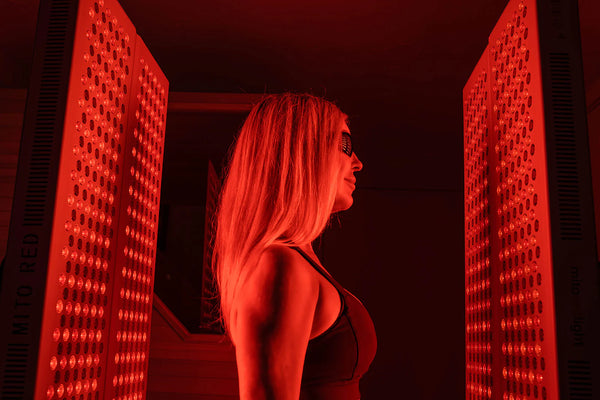
Panel Series
Red light therapy and blue light therapy use different wavelengths that work through fundamentally different biological mechanisms. Red light (630–680nm) works through photobiomodulation — activating cytochrome c oxidase (CCO) in mitochondria to support cellular energy, collagen production, and skin repair at depth. Blue light (415–465nm) works through a photochemical antimicrobial mechanism — activating bacterial porphyrins to generate localized reactive oxygen species that damage Cutibacterium acnes. Different mechanisms, different tissue targets, different clinical applications — and understanding the distinction determines which one you should actually be reaching for.
For the full cellular mechanism behind red and near-infrared light, see the science of photobiomodulation. For the clinical evidence on skin and anti-aging outcomes, see the skin and anti-aging clinical evidence page.
This article was reviewed for scientific accuracy by Dr. Alexis Cowan, PhD in Molecular Biology (Princeton University), who specializes in mitochondrial function and photobiomodulation research.
Red vs. Blue Light Therapy: At a Glance
| Feature | Red Light Therapy | Blue Light Therapy |
|---|---|---|
| Wavelength range | 630–680nm (red); 810–850nm (NIR) when combined | 415–465nm; most acne protocols use 415–420nm |
| Primary mechanism | Photobiomodulation — CCO activation → ATP ↑, NO release, collagen pathway signaling | Photochemical antimicrobial — porphyrin activation → ROS generation → bacterial damage |
| Primary tissue target | Dermis and fibroblasts — mid-to-deep skin where collagen is produced | Epidermis and sebaceous gland zone — uppermost layers where C. acnes resides |
| Primary applications | Collagen support, fine lines, skin rejuvenation, redness, wound healing, deeper tissue recovery | Mild-to-moderate acne, inflammatory lesions, surface bacterial load reduction |
| Side effect profile | Mild, transient — fewer adverse effects than blue in head-to-head acne trials[1] | Mild — possible temporary dryness, redness; dose-dependent oxidative risk at higher exposures[5] |
| Combined? | Yes — blue targets surface bacteria, red supports inflammation modulation and healing. Combined protocols outperform blue light alone for acne.[2] | |
Why the Mechanisms Are Completely Different
Most comparisons of red and blue light therapy focus on application categories without explaining why they differ. The mechanism distinction is what makes the comparison meaningful — and what determines which wavelength is actually appropriate for a given goal.
How Red Light Works
Red light (630–680nm) is absorbed by cytochrome c oxidase (CCO) — the terminal enzyme of the mitochondrial electron transport chain — which is present in virtually every cell in the body. When red photons reach CCO in dermal fibroblasts and keratinocytes, they trigger increased ATP production, nitric oxide release, and modulation of reactive oxygen species as secondary messengers. Quirk and Whelan's 2020 review in Photobiomodulation, Photomedicine, and Laser Surgery discusses the CCO-nitric oxide axis as the leading mechanistic hypothesis driving PBM effects across the red and NIR spectrum.[9]
In skin, this activates the energy metabolism of fibroblasts — the cells responsible for collagen and elastin synthesis. Barolet's 2009 study in the Journal of Investigative Dermatology measured a 31% increase in type-1 procollagen and 18% reduction in MMP-1 (the collagen-degrading enzyme) following 12 sessions of 660nm LED, with more than 90% of participants showing measurable wrinkle reduction.[3] Mota et al. (2023) confirmed a 31.6% reduction in periocular wrinkle volume in a randomized controlled trial.[4]
How Blue Light Works
Blue light (415–465nm) does not activate CCO at meaningful levels. Its mechanism is entirely different: blue photons are absorbed by porphyrins — light-sensitive compounds produced as metabolic byproducts by Cutibacterium acnes. This absorption generates singlet oxygen and reactive oxygen species that are cytotoxic to the bacteria at the exposure site. The mechanism is photochemical and antimicrobial — not mitochondrial.
Leanse et al.'s 2022 review in Advanced Drug Delivery Reviews documented the breadth of the antimicrobial blue light mechanism, noting that 415–420nm wavelengths fall within the peak absorption range of porphyrins — making this the most photochemically efficient antimicrobial wavelength for C. acnes.[6]
Werner et al. (2025) in Biomedicine & Pharmacotherapy added an important nuance — blue light has a dual role in skin: anti-inflammatory and antimicrobial at therapeutic doses, but potentially pro-oxidative in skin cells at higher doses or extended exposures.[5] This is why dose and protocol parameters matter for blue light use — the "less is more" principle applies, particularly for longer-term routines.
"The comparison between red and blue light therapy is really a comparison between two completely different photochemical interactions. Red light at 660nm is absorbed by cytochrome c oxidase — a direct mitochondrial photoreceptor. The downstream effects are broad: ATP, nitric oxide, secondary messenger cascades. Blue light at 415nm is absorbed by bacterial porphyrins — it's essentially a targeted antimicrobial mechanism that doesn't involve CCO at all. Grouping them under 'LED therapy' is accurate but can obscure the fact that they're working through different molecular pathways on different targets. That distinction determines which one you should actually be reaching for."
— Dr. Alexis Cowan, PhD, Molecular Biology (Princeton University), Scientific Advisor, Mito Red Light
Red vs. Blue for Acne: What the Clinical Research Shows
For acne — where both modalities have been studied head-to-head — the evidence is more nuanced than "blue is for acne, red is not." Both show efficacy for inflammatory lesions through different pathways that become additive when combined.
Li et al. (2022) in Photodermatology, Photoimmunology & Photomedicine compared red and blue light directly for mild-to-moderate acne in a randomized controlled trial — finding similar overall efficacy (36.2% improvement in the red group vs 30.7% in the blue group at 2-week follow-up, not statistically significant), with red light showing fewer adverse reactions than blue.[1]
The combination approach is where the evidence becomes most compelling. Friedmann et al. (2026) in Dermatologic Surgery compared a combined red+blue LED device against a blue-only device for at-home inflammatory acne — finding that the red+blue combination produced significantly greater reduction in Investigator's Static Global Assessment (ISGA) at 8 weeks, with significant within-group reductions in inflammatory and total acne lesions at both 4 and 8 weeks.[2]
Jean-Pierre et al.'s 2024 review in Lasers in Medical Science surveys emerging laser and light-based options for acne, including multi-wavelength LED approaches — consistent with the direction the clinical evidence is heading.[7]
When to Use Red, Blue, or Both
Use Red Light When
- Primary goal is collagen support and anti-aging
- Addressing fine lines, texture, or overall skin quality
- Treating redness, post-procedure recovery, or surface wound healing
- You want deeper tissue benefits — muscle, joints, systemic
- Sensitive skin that reacts to blue light
- Acne is deeper, hormonal, or cystic in nature
Use Blue Light When
- Primary concern is active inflammatory acne or frequent breakouts
- Mild-to-moderate comedonal or papular acne with bacterial component
- Reducing surface C. acnes load without topical antibiotics
- Managing congestion-prone or oily skin
- Used as adjunct to other acne treatments
Use both when: Managing acne alongside skin aging or redness. Blue addresses bacterial load; red supports the inflammatory healing response and collagen repair. Combined protocols consistently outperform blue-only approaches in head-to-head research.
How Red and Blue Light Fit Into At-Home Routines
The most practical at-home implementation of combined red and blue is a multi-wavelength LED mask with selectable modes. The MitoGLOW LED Mask — FDA 510(k) cleared (K221775) as a light-based OTC wrinkle reduction device — includes four wavelength modes designed specifically for this:
- 465nm blue — antimicrobial, targets C. acnes porphyrins for acne-focused protocols
- 590nm amber — surface redness and tone support
- 630nm red — collagen pathway signaling, surface skin rejuvenation
- 830nm near-infrared — deeper dermal support and anti-inflammatory signaling
For full-body applications — skin coverage alongside muscle, joint, and systemic benefits — red and near-infrared panels are the right format. The MitoPRO X Series delivers multiple wavelengths covering surface to deep tissue. Blue light is not included in full-body panels because its antimicrobial application is face-specific and impractical at panel distances.
For skincare timing around sessions, see what to apply before and after red light therapy. For the full peer-reviewed evidence base organized by health category, see the research evidence hub. The database of over 9,500 peer-reviewed studies is searchable at mitoredlight.com/pages/evidence-explorer.
Frequently Asked Questions
Is red light or blue light better for anti-aging?
Red light is significantly more effective for anti-aging because it activates cytochrome c oxidase in dermal fibroblasts — the cells responsible for collagen synthesis. Barolet (2009) demonstrated a 31% increase in procollagen following 660nm LED treatment; Mota et al. (2023) confirmed a 31.6% wrinkle volume reduction in an RCT. Blue light's porphyrin-activation mechanism has no meaningful direct effect on the collagen pathway — it is not a primary anti-aging tool.
Which is better for acne — red or blue light?
Both show comparable efficacy for mild-to-moderate inflammatory acne through different mechanisms: blue targets C. acnes bacteria directly, red modulates the inflammatory response. Li et al. (2022) found similar improvement rates in a head-to-head RCT, with red light reporting fewer adverse effects. The combination of both outperforms blue light alone — Friedmann et al. (2026) found significantly greater ISGA improvement with red+blue vs blue-only at home.
Can I use red and blue light therapy in the same session?
Yes — the evidence supports it for acne. Blue targets bacterial load; red supports inflammation modulation and healing. Combined protocols consistently outperform either wavelength alone. The MitoGLOW LED Mask provides both modes in a single face-focused device, making combined sessions practical at home.
Does blue light penetrate as deeply as red light?
No. Blue light (415–465nm) is absorbed in the epidermis and uppermost dermis — primarily in the superficial layers where C. acnes and sebaceous glands reside. Red light (630–680nm) penetrates to the mid-to-deep dermis where fibroblasts are active. Near-infrared (810–850nm) travels deeper still into subcutaneous tissue and muscle. Penetration depth increases systematically with wavelength — a fundamental optical property of light-tissue interaction. See the wavelength reference page for detailed penetration depth data.
Is blue light therapy safe for long-term use?
Werner et al. (2025) in Biomedicine & Pharmacotherapy noted a dose-dependent dual role for blue light: therapeutic at appropriate LED doses and durations, potentially pro-oxidative in skin cells at higher doses or extended exposures. Standard LED protocols with controlled session times are generally well tolerated. The "more is not better" principle is associated more strongly with blue than with red wavelengths, which is why following device-specific guidelines matters for blue light routines. Consult a qualified healthcare professional if you are managing a skin condition.
Should I choose a red light panel or a multi-wavelength LED mask?
It depends on your goals. For comprehensive skin and body benefits — collagen, muscle recovery, joints, systemic wellness — a red and near-infrared panel covers larger areas and deeper tissue. For face-focused protocols that include acne management, a multi-wavelength mask with red, NIR, and blue modes gives you flexibility for both goals in one device.
References
- Li J, et al. (2022). Comparison of red light and blue light therapies for mild-to-moderate acne vulgaris: A randomized controlled clinical study. Photodermatology, Photoimmunology & Photomedicine. PMID 34981580
- Friedmann DP, et al. (2026). Comparing a Red and Blue Light-Emitting Diode Light Device With an Existing Blue Light Device for At-Home Treatment of Inflammatory Acne: An Open-Label Randomized-Controlled Trial. Dermatologic Surgery. PMID 41886698
- Barolet D, et al. (2009). Regulation of skin collagen metabolism in vitro using a pulsed 660 nm LED light source: clinical correlation with a single-blinded study. Journal of Investigative Dermatology. PMID 19587693
- Mota LR, et al. (2023). Photobiomodulation Reduces Periocular Wrinkle Volume by 30%: A Randomized Controlled Trial. Photobiomodulation, Photomedicine, and Laser Surgery. PMID 36780572
- Werner A, et al. (2025). The two faces of blue light: From treating inflammation to causing oxidative stress in the skin. Biomedicine & Pharmacotherapy. PMID 40819541
- Leanse LG, Dos Anjos C, Mushtaq S, Dai T. (2022). Antimicrobial blue light: A 'Magic Bullet' for the 21st century and beyond? Advanced Drug Delivery Reviews. PMID 34800566
- Jean-Pierre V, et al. (2024). Emerging lasers and light-based therapies in the management of acne: a review. Lasers in Medical Science. PMID 39340675
- Quirk BJ, Whelan HT. (2020). What Lies at the Heart of Photobiomodulation: Light, Cytochrome C Oxidase, and Nitric Oxide-Review of the Evidence. Photobiomodulation, Photomedicine, and Laser Surgery. PMID 32716711
This article discusses published scientific research and general educational information about photobiomodulation and red light therapy. It does not constitute medical advice and does not make specific claims about Mito Red Light devices. The research cited reflects independent peer-reviewed studies and does not imply that any Mito Red Light product has been evaluated, approved, or cleared by the FDA or any other regulatory body for the diagnosis, treatment, cure, or prevention of any disease or medical condition. Individual results vary. Consult a qualified healthcare professional before beginning any light therapy protocol, particularly if you have a pre-existing medical condition, are pregnant, or are taking photosensitising medications.
Mito Red Light products are general wellness devices. They are not medical devices and have not been evaluated, cleared, or approved by the FDA or any regulatory body for the diagnosis, treatment, cure, or prevention of any disease or medical condition. Any references to peer-reviewed research or clinical studies on this page describe findings from independent scientific literature and do not imply that Mito Red Light devices have been studied, tested, or proven effective for any specific condition. Always consult a qualified healthcare provider before beginning any new wellness routine, particularly if you have a medical condition or are taking medication.
Related articles
More from the red light therapy knowledge cluster