














Panel Series
A common question in the red light therapy community is whether applying a serum before a session makes the results measurably better — or whether the light is doing all the work regardless of what's on your skin. The answer, based on a 12-week split-face comparative study we commissioned at SKINLAB P.S.A., a certified cosmetic testing laboratory in Kraków, is that the combination produced consistent, instrumentally measured improvements across every skin parameter tested compared to red light alone.
This article explains what we studied, what the instruments measured, and why the combination may produce better outcomes than either approach used separately.
What the Study Measured and How
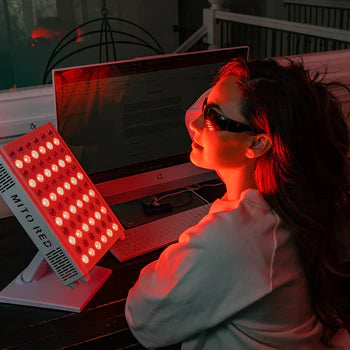
The study ran from January to May 2026 under the supervision of a licensed dermatologist. Ten female volunteers aged 42–61 completed a 12-week protocol in which each participant applied the MitoAURA Activate + Amplify Serum to one half of their face and then exposed the entire face to red light from the MitoPRO 300+ panel for 10 minutes at a distance of 12 inches, five days per week. The other half of the face received the same light exposure without the serum — making each participant their own control and eliminating the variability of comparing different individuals.
Skin measurements were taken at the SKINLAB P.S.A. laboratory at baseline and after 12 weeks using three specialized instruments: the NATI V3 for wrinkle and melanin analysis, the ASW 300 for acne and inflammation scoring, and the DermaLab Combo for erythema measurement. No adverse side effects were reported by any volunteer.
| Parameter | Red Light Alone | Red Light + MitoAURA Serum |
|---|---|---|
| Wrinkle width | −13.29% | −19.22% |
| Melanin level | −8.57% | −13.63% |
| Acne/inflammation score | −14.11% | −21.56% |
| Erythema level | −9.91% | −16.45% |
In every parameter, the side treated with both red light and the serum showed greater improvement than the side treated with red light alone. The differences ranged from approximately 5 to 7.5 percentage points across outcomes.
Why the Serum May Enhance Red Light Therapy Results
Red light therapy — also referred to as photobiomodulation (PBM), the use of specific wavelengths of non-thermal light to stimulate cellular function — supports skin at the cellular level by activating cytochrome c oxidase (CCO, the terminal enzyme in the mitochondrial electron transport chain), which drives increased adenosine triphosphate (ATP) production, modulates reactive oxygen species (ROS, unstable molecules that act as secondary messengers in cellular stress signaling), and stimulates growth factor and collagen synthesis. The MitoAURA serum contains three ingredients that address overlapping but distinct biological targets — which is likely why the combination outperformed light alone on every measure.
"Photobiomodulation drives mitochondrial ATP production and initiates secondary signaling cascades that support collagen synthesis and cellular repair. What's often underappreciated is that the skin's capacity to respond to that signal depends on its baseline redox state - oxidative burden at the cellular level can attenuate the response. Topical antioxidants that reduce that burden before a session aren't redundant with the light; they're potentially preparing the cellular environment to respond more fully to it."
— Dr. Alexis Cowan, PhD, Molecular Biology (Princeton University), Scientific Advisor, Mito Red Light
Methylene Blue
The serum contains Methylthioninium Chloride, commonly known as methylene blue (MB), a mitochondria-targeting antioxidant with a direct mechanism of action on skin cells. Research published in Scientific Reports found that MB was more effective than other commonly used antioxidants in stimulating skin fibroblast proliferation and delaying cellular senescence [Xiong et al. 2017, PMID 28559565]. The same research showed that MB treatment altered the expression of extracellular matrix proteins in a 3D human skin model, including upregulation of elastin and collagen 2A1, two structural proteins central to skin firmness and appearance. A review in Oxidative Medicine and Cellular Longevity identified MB as among the most significant extenders of fibroblast replicative lifespan among all antioxidants studied, with effects attributed to direct ROS scavenging and activation of cellular signaling pathways [Sadowska-Bartosz & Bartosz 2020, PMID 33029282].
This is directly relevant to the study results: the split-face design showed greater reductions in both wrinkle width (−19.22% vs −13.29%) and erythema (−16.45% vs −9.91%) on the serum side — outcomes consistent with the mechanisms MB is proposed to support at the fibroblast and extracellular matrix level.
Tetrahexyldecyl Ascorbate (Stable Vitamin C)
The serum uses Tetrahexyldecyl Ascorbate, a lipid-soluble form of vitamin C known for its dermal penetration stability. A review in the Journal of Clinical and Aesthetic Dermatology characterized topical vitamin C as one of the most powerful antioxidants in the skin, with roles in collagen synthesis promotion, stabilization of collagen fibers, decreased collagen degradation, and reduction of melanin formation [Al-Niaimi & Chiang 2017, PMID 29104718]. The melanin reduction effect is particularly relevant here: the serum side showed a 13.63% decrease in instrumentally measured melanin levels versus 8.57% for red light alone — a difference of more than 5 percentage points that aligns with vitamin C's established antipigmentary mechanism.
Spirulina Platensis Extract
The serum's first listed active after water and glycerin is Spirulina Platensis Extract. A 2022 review in Plants examined the topical skin properties of cyano-phycocyanin — the active pigment isolated from Spirulina — and documented antioxidative, anti-inflammatory, antimelanogenic, and wound-healing properties through topical application [Dranseikienė et al. 2022, PMID 35567250]. These properties span multiple parameters measured in the study: inflammation scoring, melanin levels, and erythema all improved more markedly on the serum side.
What the Red Light Alone Achieved
It is important to be clear that the MitoPRO 300+ panel produced meaningful improvements on its own across all four parameters without any serum — including a 13.29% reduction in wrinkle width and a 14.11% improvement in acne/inflammation scoring over 12 weeks.
This is consistent with the broader photobiomodulation literature on red light and skin. A 2023 clinical study published in Skin Research and Technology demonstrated that twice-weekly red LED sessions at 630nm over three months produced progressive improvements in facial wrinkle depth, skin firmness, dermis density, and complexion homogeneity in 20 women, with results lasting up to one month after the protocol ended [Couturaud et al. 2023, PMID 37522497]. A randomized controlled trial published in Photobiomodulation, Photomedicine, and Laser Surgery found that a split-face protocol using 660nm red PBM produced a 31.6% reduction in periocular wrinkle volume in 137 women over 10 sessions [Mota et al. 2023, PMID 36780572].
The red light was doing meaningful work on its own. The serum amplified that work across every outcome measured. For a deeper look at how red and near-infrared light trigger the cellular response that drives these skin outcomes, see how photobiomodulation works at the cellular level. For the peer-reviewed studies on skin and anti-aging organized by subcategory, Mito Red Light's clinical evidence hub for skin and anti-aging compiles the relevant literature. A broader index of clinical PBM research across all health categories is available at Mito Red Light's clinical research evidence hub.
Why a Split-Face Design Provides Useful Signal
The split-face design used in this study is a standard methodology in cosmetic clinical testing. By having each participant serve as their own control — one side receiving red light plus serum, the other red light alone — the design eliminates inter-individual variability in skin type, baseline condition, sun exposure, and lifestyle. What remains is the differential effect attributable to the serum.
This does not make the study equivalent to a large-scale randomized controlled trial. With 10 participants, these are early-stage findings from a certified cosmetic evaluation laboratory conducted under EU cosmetics regulation (EC 1223/2009). They are meaningful and directionally consistent, but they represent a starting point rather than a definitive clinical conclusion. The appropriate framing is that in this 12-week instrumental evaluation, adding the serum to the red light protocol was associated with greater improvements across all four measured skin parameters.
How to Use the Combination
The protocol used in this study was straightforward:
- Apply the MitoAURA Activate + Amplify Serum to clean skin
- Immediately expose the face to red light from the MitoPRO 300+ at a distance of approximately 12 inches
- Session duration: 10 minutes
- Frequency: five days per week
- Study duration: 12 weeks
The serum was applied immediately prior to light exposure — not after. Applying before the session may allow active ingredients to be in place as the light-driven cellular response begins, though the precise timing mechanism is not yet established in the literature. See also Skincare Before or After Red Light Therapy?
For guidance on device selection, irradiance thresholds, and what to look for when building an at-home protocol, the red light therapy buyer's guide covers the key specifications in detail. You can also explore over 9,500 peer-reviewed PBM studies in Mito Red Light's Evidence Explorer, organized by health category and study type.
Frequently Asked Questions
Should I apply a serum before or after red light therapy?
In the 12-week study described here, the serum was applied immediately before red light exposure. Both red light alone and the red light plus serum combination produced improvements across all four measured parameters, with the serum side showing greater improvement in every category. The research on optimal timing for topical application around light sessions remains limited; applying a serum formulated for pre-session use immediately before is the approach supported by this study's protocol.
Does red light therapy help with wrinkles?
Research supports red light's role in supporting the appearance of skin over time. In this study, 12 weeks of red light therapy alone was associated with a 13.29% reduction in measured wrinkle width. Independent clinical research has found similar directional outcomes: a 2023 randomized controlled trial found approximately 31.6% wrinkle volume reduction with a 660nm red light protocol over 10 sessions. These are cosmetic and wellness outcomes, not medical treatments.
What makes the MitoAURA serum different from a standard vitamin C serum?
The MitoAURA Activate + Amplify Serum combines Tetrahexyldecyl Ascorbate (a stable lipid-soluble form of vitamin C), Spirulina Platensis Extract, and Methylthioninium Chloride (methylene blue) — each with published research on distinct skin mechanisms including antioxidant activity, melanin modulation, fibroblast support, and anti-inflammatory properties. The study's split-face results suggest the combination of these actives with red light produced better outcomes than red light alone across all four measured parameters.
Is the MitoAURA serum safe to use daily?
No adverse side effects were reported by any of the 10 volunteers in the 12-week study, which was conducted under dermatologist supervision. The serum was applied five days per week throughout the study period without observed irritation, and the study was conducted under EU cosmetics regulation (EC 1223/2009).
How long does it take to see results from red light therapy on skin?
In this study, measurements were taken at baseline and after 12 weeks. The clinical literature on red light and skin aging generally shows progressive improvements over 4–12 weeks of consistent use. Individual results depend on baseline skin condition, session frequency, device irradiance, and treatment area coverage.
References
- Xiong Z-M, O'Donovan M, Sun L, Choi JY, Ren M, Cao K. Anti-Aging Potentials of Methylene Blue for Human Skin Longevity. Sci Rep. 2017;7(1):2475. PMID: 28559565
- Sadowska-Bartosz I, Bartosz G. Effect of Antioxidants on the Fibroblast Replicative Lifespan. Oxid Med Cell Longev. 2020;2020:6423783. PMID: 33029282
- Al-Niaimi F, Chiang NYZ. Topical Vitamin C and the Skin: Mechanisms of Action and Clinical Applications. J Clin Aesthet Dermatol. 2017;10(7):14–17. PMID: 29104718
- Couturaud V, Le Fur M, Pelletier M, Granotier F. Reverse skin aging signs by red light photobiomodulation. Skin Res Technol. 2023;29(7):e13391. PMID: 37522497
- Mota LR, Duarte IDS, Galache TR, et al. Photobiomodulation Reduces Periocular Wrinkle Volume by 30%: A Randomized Controlled Trial. Photobiomodul Photomed Laser Surg. 2023;41(2):48–56. PMID: 36780572
- Dranseikienė D, Balčiūnaitė-Murzienė G, Karosienė J, et al. Cyano-Phycocyanin: Mechanisms of Action on Human Skin and Future Perspectives in Medicine. Plants (Basel). 2022;11(9):1249. PMID: 35567250
This information is for educational purposes and is not medical advice. Consult your healthcare provider before starting any new wellness practice, especially if you have a medical condition or take medications.
Mito Red Light products are general wellness devices. They are not medical devices and have not been evaluated, cleared, or approved by the FDA or any regulatory body for the diagnosis, treatment, cure, or prevention of any disease or medical condition. Any references to peer-reviewed research or clinical studies on this page describe findings from independent scientific literature and do not imply that Mito Red Light devices have been studied, tested, or proven effective for any specific condition. Always consult a qualified healthcare provider before beginning any new wellness routine, particularly if you have a medical condition or are taking medication.