















Panel Series
By Scott Chaverri
Medically Reviewed by | Heidi Wright, BSN, RN, PCCN
Vitamin D and red light therapy are two of the most talked‑about topics in modern wellness—and for good reason. Vitamin D plays a crucial role in bone health, immune resilience, and overall vitality, while red light therapy works on a completely different part of the light spectrum to support cellular energy and recovery. It is natural to ask whether these two are connected and whether a red light therapy device can help with vitamin D levels.
The short answer is that only ultraviolet B (UVB) light directly produces vitamin D in the skin, but red and near‑infrared light may still influence how your skin responds to sunlight. Emerging research suggests that red light may help protect skin against UVB damage and support a healthier skin barrier, potentially allowing you to spend more time in sensible sunlight—the true driver of vitamin D—without burning as quickly. That makes red light therapy a complementary, not replacement, tool in a vitamin D strategy.
In this guide, we will cover what vitamin D actually does, how it relates to immune and bone health, what my own lab results revealed, and how a daily routine that combines moderate sun exposure with Mito Red Light sessions may fit into a broader approach to vitamin D and skin health. We will also look at what the science does—and does not—say about red light therapy and vitamin D production so you can set realistic expectations.
Table of Contents
- What is Vitamin D
- Vitamin D and COVID-19
- What the Science Shows
- What the Experts Say
- Vitamin D and Bone Health
- Getting Vitamin D
- Foods with Vitamin D
- Vitamin D Supplements
- UV Light
- The Reason for this Article - My Recent Vitamin D Results
- Red Light Therapy and Vitamin D
- Skin Protection
- Skin Thickening
- Red Light Therapy
What is Vitamin D?
According to the National Institute on Aging, vitamins are nutrients that your body needs to survive and stay healthy. Vitamin D, also called calciferol, plays an important role in bone health and in regulating the immune system.
Vitamin D is naturally made in the body, but only when skin cells are stimulated with specific wavelengths of ultraviolet (UV) light. These wavelengths naturally occur in sunlight, and exposure to sunlight or artificial UVB light can stimulate the production of vitamin D. Vitamin D is also obtained from foods that contain it; however, there are not many foods that have high amounts of vitamin D.
Once produced, vitamin D is not active until it undergoes two processes in the liver and kidneys to become calcitriol, the active form that exerts its effects in the body.
While vitamin D is an important nutrient, many people are deficient. It is estimated that around one billion people worldwide have vitamin D deficiency. Scientists hypothesize that this is largely due to the decreased time people spend outdoors in modern life, which reduces exposure to the sunlight needed to make vitamin D.
Vitamin D and COVID-19
Vitamin D has been shown to be connected with immune system health, and as research into vitamin D continues to grow, more scientists are considering its potential to decrease the risk of certain viral infections.
What the Science Shows
Since relatively early in the COVID-19 pandemic, the relationship between low vitamin D levels and the risk of severe COVID-19 has been an area of interest. Studies have found that those with COVID-19 infections are more likely to have lower vitamin D levels than the average person, leading many to infer that low vitamin D may increase the risk of infection. A study out of the University of Chicago Medicine found that people with higher vitamin D levels were at a lower risk of developing COVID-19.
Another study found that people living closer to the equator were less likely to die from COVID-19. Because equatorial regions receive more sunlight, the researchers believe this supports the idea that vitamin D may decrease COVID‑19 risk.
What the Experts Say
Chris D’Adamo, PhD, director of the Center for Integrative Medicine at the University of Maryland School of Medicine, wrote a COVID‑19 prevention guide in which he said, “Vitamin D is one of the most important and powerful nutrients for supporting the immune system. Numerous studies have shown that it helps reduce the risk of colds and flu. Unfortunately, a high percentage of the population is deficient, so daily supplementation (ideally in the form of vitamin D3) offers the best protection.”
Anthony Fauci, MD, has similarly said in interviews, “If you are deficient in vitamin D, that does have an impact on your susceptibility to infection. So I would not mind recommending, and I do it myself, taking vitamin D supplements.”
While there is solid research suggesting vitamin D supports immune health and may reduce the risk of severe COVID‑19, some mainstream sources have expressed skepticism about how large the effect truly is, noting that more rigorous trials are needed. It is also worth noting that vitamin D is inexpensive and not a proprietary product, which may influence how aggressively it is promoted compared to patented therapies.
For a deeper discussion of the research, we recommend this MedCram video:
Vitamin D and Bone Health
Beyond immune health, vitamin D is essential for bone health. It was first recognized as important in the context of rickets, a bone condition that occurs with severe deficiency. Vitamin D plays a key role in helping the body absorb phosphorus and calcium—two minerals critical for bone growth, development, and maintenance.
While severe deficiencies are needed to cause conditions as dramatic as rickets, vitamin D is still essential for everyday bone health. Conditions like osteoarthritis and osteoporosis have been shown in some cases to improve with adequate vitamin D and calcium intake.
Getting Vitamin D

While vitamin D is essential, there are only a few ways we can reliably obtain enough of it: diet, supplements, and exposure to sunlight or other UVB light sources.
Foods with Vitamin D
Dietary vitamin D options are quite limited. Oily fish like sardines, salmon, and herring are good sources, as are fish liver, liver, red meats, and egg yolks. Some foods are fortified with vitamin D (such as certain dairy products and cereals), meaning vitamin D is added to them to boost intake.
Vitamin D Supplements
Because relatively few foods naturally provide vitamin D, many people rely on supplements either alone or in combination with other nutrients. Supplements can help avoid deficiency, but absorption and dosing can vary, which is one reason some researchers emphasize pairing supplementation with sensible light exposure. This article from the Mito Red Light research library explores the limitations of relying solely on pills for vitamin D.
UV Light
UV light is how our bodies naturally produce most of our vitamin D. UV light is divided into three bands based on wavelength; only one of these—UVB, at 280–315 nm—stimulates vitamin D production.
UVB is produced naturally by the sun, but much of it is absorbed by the atmosphere, with only a fraction reaching the earth’s surface. UVB exposure is highest when the sun is higher in the sky (midday) and during the summer months. Spending a short, unburned amount of time in midday sun with exposed skin is one of the most efficient ways to make vitamin D.
An excellent app to help you know when the sun is strong enough to make vitamin D is DMinder.
The Reason for this Article – My Recent Vitamin D Results
The impetus for this article was the results of recent vitamin D blood tests I had done.
On March 19, 2021, my vitamin D blood test came back at 86.4 ng/mL—exceptionally high, even above the typical “optimal” range.
Here’s the important part: I do not take vitamin D supplements. Nor do I take any supplements that contain meaningful amounts of vitamin D (such as cod liver oil).

I was so surprised by these results that I assumed there might be an error, so I re-tested one month later. That test came back at 77.8 ng/mL—still very high, but consistent.

Prior to these tests, I would have assumed the only way to reach these levels was by taking high-dose vitamin D supplements.
So what was going on? Which aspects of my lifestyle were driving this? It is likely a combination of factors, but my light routine is a major one:
- Upon waking: Immediately go outside and spend 5–10 minutes in direct sunlight.
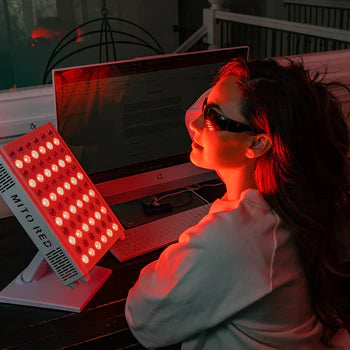
- 8:30 a.m.: At the office, do 8–10 minutes of whole-body red light therapy using Mito Red panels.
- 11 a.m.–1 p.m.: Spend 10–15 minutes walking outside in the Arizona sun with my shirt off.
- Sunset: Try to watch or be outside around sunset when possible.
- After sunset: Wear blue-blocking glasses and minimize bright light and screen time.

Current red light setup at Mito Red Light HQ
Red Light Therapy and Vitamin D
While red light therapy has many potential benefits, the wavelengths emitted by red and near‑infrared devices are not the same UVB wavelengths that directly stimulate vitamin D production. Recent research, however, suggests that while red light therapy does not create vitamin D itself, it may prepare and protect your skin in ways that optimize your time in the sun.
Red and near‑infrared light are relatively more abundant at sunrise and sunset. Some researchers hypothesize that morning light may “precondition” the skin to better tolerate and use midday UVB exposure. Other work has explored how LED red light can modulate collagen, barrier proteins, and oxidative stress markers in skin exposed to UVB.
So, could my morning routine of early outdoor light and Mito Red Light sessions be priming my skin to more efficiently produce vitamin D during the few minutes I am outside at midday? The science is still evolving, but it is a plausible and exciting hypothesis.

Skin Protection
Red light uses longer, lower‑energy wavelengths that penetrate deeper into tissue than higher‑energy light. In a study published in the Journal of Photochemistry and Photobiology B, researchers found that red and near‑infrared light could protect against some UVB‑induced damage. When a test subject’s arm was treated with red and infrared light before sun exposure, the resulting sunburn was lessened as pretreatment wavelengths and doses increased.

The protective effects of red light may allow people to safely get a bit more sun exposure without burning as quickly. In turn, that could increase the window in which UVB light can stimulate vitamin D production—again, without red light itself generating vitamin D.
Skin Thickening
In addition to offering photoprotective effects, studies have also found that red light therapy can contribute to skin thickening by supporting collagen and dermal matrix. The same process many people use red light for—reducing wrinkles and enhancing skin appearance—may also increase the number and volume of cells in the dermis that can absorb UVB and synthesize vitamin D precursors.
Red Light Therapy
While red light therapy does not directly create vitamin D, it may create a skin environment that is more capable of producing it when you do get UVB exposure. Scientific studies suggest that red and near‑infrared light may help protect skin from UVB‑induced damage and support collagen and barrier proteins, making it safer to get sensible sun. Red light therapy may also increase the number or health of cells that participate in vitamin D synthesis, potentially maximizing the benefit of time spent outdoors. See also Infrared Sauna vs. Red Light Therapy.
With vitamin D being so important for overall health and wellness, this interplay between sunlight, UVB, and red light therapy will remain an ongoing area of inquiry for us at Mito Red Light.
Frequently Asked Questions
Can red light therapy directly increase vitamin D levels?
No. Vitamin D production depends on ultraviolet B (UVB) light in the 280–315 nm range, while red light therapy uses red and near‑infrared wavelengths that do not trigger vitamin D synthesis. Red light therapy may still complement a vitamin D strategy by supporting skin health and tolerance to sensible sun exposure.
Is red light therapy a replacement for sunlight or vitamin D supplements?
Red light therapy is not a replacement for UVB exposure or medically supervised vitamin D supplementation. It should be viewed as a complementary tool that supports cellular health and may help you get more benefit from safe sun exposure, not as a standalone vitamin D solution.
How might red light therapy and vitamin D work together?
Some research suggests that red and near‑infrared light can help protect skin from UVB damage and support collagen and barrier function. In theory, that could allow you to spend slightly more time in the sun without burning as quickly, potentially improving natural vitamin D production while protecting skin quality.
Do I still need sunscreen if I use red light therapy?
Yes. Red light therapy does not block UV rays or prevent sunburn. You should continue to use sunscreen, protective clothing, and shade when UV levels are high, even if you are incorporating red light therapy into your routine.
Which Mito Red Light devices are best if I want to support overall wellness and vitamin D routines?
Full‑body and larger panel devices in the Mito PRO or MitoMOD series are popular choices for pairing with a sunlight routine because they cover more skin surface area in a short session. Handheld or smaller panels can still be useful for targeted use when time or space is limited.
This article discusses published scientific research and general educational information about photobiomodulation and red light therapy. It does not constitute medical advice and does not make specific claims about Mito Red Light devices. The research cited reflects independent peer-reviewed studies and does not imply that any Mito Red Light product has been evaluated, approved, or cleared by the FDA or any other regulatory body for the diagnosis, treatment, cure, or prevention of any disease or medical condition. Individual results vary. Consult a qualified healthcare professional before beginning any light therapy protocol, particularly if you have a pre-existing medical condition, are pregnant, or are taking photosensitising medications.
Mito Red Light products are general wellness devices. They are not medical devices and have not been evaluated, cleared, or approved by the FDA or any regulatory body for the diagnosis, treatment, cure, or prevention of any disease or medical condition. Any references to peer-reviewed research or clinical studies on this page describe findings from independent scientific literature and do not imply that Mito Red Light devices have been studied, tested, or proven effective for any specific condition. Always consult a qualified healthcare provider before beginning any new wellness routine, particularly if you have a medical condition or are taking medication.
Related articles
More from the conditions & research knowledge cluster