











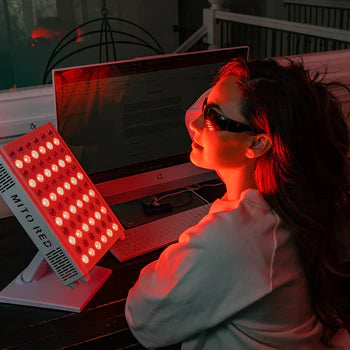



Panel Series
Red light therapy contraindications are situations where use should be avoided or requires medical clearance first. The most important absolute contraindications are: active cancer or suspicious lesions in the treatment area, photosensitive epilepsy, and direct intentional eye exposure without professional guidance. Important relative contraindications — situations requiring medical clearance rather than outright avoidance — include pregnancy over the abdomen, photosensitizing medications, systemic lupus, hyperthyroidism, active infection or fever, and reduced sensation from neuropathy. Red light therapy is generally well tolerated in the published research for healthy adults when used as directed, but individual health status, device quality, and correct use all matter.
This article covers who should avoid red light therapy, who should get clearance first, and how to use it more safely. For the clinical evidence on PBM safety parameters and wavelength-specific findings, see the safety parameters and wavelengths clinical evidence page. For the full research library organized by health category, see the research evidence hub.
Red Light Therapy Contraindications at a Glance
This table is a summary only — not a substitute for medical advice. If you have a diagnosed condition, take prescription medications, are pregnant, or are unsure whether light therapy is appropriate for you, ask a qualified healthcare professional before starting.
| Situation | Risk Level | General Guidance | Who to Ask |
|---|---|---|---|
| Active cancer or suspicious lesion in the treatment area | Avoid unless cleared | Do not apply red light therapy directly over known or suspected malignant tissue without oncology team approval | Oncologist or dermatologist |
| Photosensitive epilepsy or seizure sensitivity | Avoid unless cleared | Visible flicker, pulsing, or strobing light can be a trigger — ask your neurologist before any use | Neurologist |
| Intentional direct eye exposure (high-intensity) | Avoid unless supervised | Do not intentionally shine high-intensity red or NIR light into the eyes without professional supervision | Ophthalmologist |
| Pregnancy — abdomen or low back | Medical clearance | Do not direct red light toward the abdomen or low back during pregnancy without OB-GYN approval | OB-GYN or midwife |
| Photosensitizing medications | Check first | Review medication labels and ask your prescriber or pharmacist before starting | Prescribing clinician or pharmacist |
| Lupus (SLE) or diagnosed photosensitivity disorder | Medical clearance | Individual sensitivity varies — ask your rheumatologist or dermatologist before starting and start conservatively if cleared | Rheumatologist or dermatologist |
| Active eye disease (retinal conditions, glaucoma, macular degeneration) | Medical clearance | PBM is being studied in ophthalmology but under controlled clinical protocols — not the same as unsupervised home use | Ophthalmologist |
| Hyperthyroidism or active thyroid disease | Medical clearance for neck area | Avoid applying directly over the neck or upper chest until cleared by your endocrinologist | Endocrinologist |
| Recent burns or acute heat injury | Pause — ask clinician | Avoid use over fresh burns in the first 24–48 hours unless the treating clinician says it is appropriate | Primary care, urgent care, or wound clinician |
| Fever, acute infection, or severe bleeding | Pause and ask | Delay non-urgent sessions while acutely ill, febrile, or actively bleeding — medical care takes priority | Treating clinician |
| Reduced sensation or neuropathy | Use with caution | Inability to detect heat accurately increases overuse risk — shorter sessions, inspect skin before and after | Primary care or neurologist |
Red Light Therapy Safety: What the Research Shows
Red and near-infrared light are non-ionizing — they do not carry the DNA-damaging risk associated with ultraviolet radiation. When used at appropriate irradiance levels within the therapeutic window, the evidence base for PBM safety is reassuring across a wide range of populations and applications.
Coelho et al. (2025) published a randomized controlled trial in Lasers in Medical Science specifically examining the dose-dependent safety and tolerability of transcranial PBM (808nm) — finding no significant association between dose and adverse event rates across dosing conditions, with the overall side-effect profile described as benign regardless of dosimetry.[1]
In ophthalmology — one of the most safety-sensitive application areas — the LIGHTSITE III trial (Jaffe et al., 2026) in Retina evaluated PBM for dry age-related macular degeneration over 24 months and reported a favorable safety profile with no signs of phototoxicity over the full study duration.[2]
In oncology support settings, Kauark-Fontes et al. (2022) in Supportive Care in Cancer examined extraoral PBM in head and neck cancer patients during radiotherapy and found no evidence of PBM impact on oncological outcomes — an important finding for the cancer contraindication discussion below.[6]
The safety profile does not mean contraindications don't matter. It means that for healthy adults using appropriately designed devices as directed, the risk-benefit calculation is generally favorable — and the contraindications that do exist are specific and identifiable, not a broad population-wide concern.
According to Dr. Alexis Cowan, PhD, who advises Mito Red Light on the photobiology of light therapy, the safety profile of red and near-infrared PBM is fundamentally linked to how the mechanism works. Because PBM operates through a photochemical pathway — photon absorption by cytochrome c oxidase driving mitochondrial signaling — rather than ionizing radiation or pharmaceutical activity, the risk profile is categorically different from UV-based therapies or systemic drugs. The contraindications that exist are almost entirely about specific situations where that mitochondrial stimulation interacts with an existing condition or medication in a way that warrants medical supervision — not about the photons themselves being inherently harmful at therapeutic doses. For the vast majority of healthy adults using devices at appropriate irradiance and distance, the research consistently shows a benign safety profile.
— Dr. Alexis Cowan, PhD, Molecular Biology (Princeton University), Scientific Advisor, Mito Red LightAbsolute vs. Relative Contraindications — What the Distinction Means
Contraindications in medicine are divided into two categories that carry meaningfully different implications:
Absolute contraindications mean use should generally be avoided unless a qualified clinician has specifically reviewed your situation and approved it. For red light therapy, the clearest absolute contraindications are: active cancer or suspicious lesions directly in the treatment area, photosensitive epilepsy, and intentional direct high-intensity eye exposure.
Relative contraindications mean the decision should be individualized — medical clearance is appropriate before starting, but use may be possible with the right protocol, conservative approach, and ongoing monitoring. Most of the situations in this article fall into this category: photosensitizing medications, lupus, pregnancy on body areas other than the abdomen, thyroid conditions in areas away from the neck.
The FDA does not publish a universal contraindication list for all consumer red light therapy devices — because products differ in design, wavelength, irradiance, and intended use. The FDA's draft guidance on photobiomodulation devices discusses testing, labeling, and safety considerations for PBM submissions (FDA PBM device guidance). FDA 510(k) clearance for a specific indication does not mean a device is appropriate for every person or medical condition (FDA device approvals and clearances).
Absolute Contraindications — Do Not Use Without Medical Clearance
Active Cancer or Suspicious Lesions in the Treatment Area
Do not apply red light therapy directly over known or suspected malignant tissue without explicit approval from your oncology team. This is the most frequently cited absolute contraindication in the PBM literature — not because there is definitive evidence that PBM promotes tumor growth, but because the theoretical concern around cellular stimulation in the presence of active malignancy warrants clinical supervision.
The nuance here matters. PBM has been extensively studied in oncology support settings — managing oral mucositis during radiotherapy, reducing chemotherapy-induced neuropathy, and supporting wound healing in cancer patients — all under clinician supervision and away from active tumor sites. A 2023 systematic review examined oncologic safety for PBM in aesthetic skin rejuvenation and found no clear evidence that PBM for skin rejuvenation promotes cancer, while emphasizing the need for continued study (PMC10309024). If you have cancer, a history of cancer in a treatment area, or an undiagnosed changing lesion, ask your oncologist or dermatologist before any use.
Photosensitive Epilepsy or Seizure Sensitivity
People with photosensitive epilepsy or light-triggered seizure sensitivity should ask their neurologist before using any red light therapy device. Some devices — particularly those using visible pulsing, strobing, or flickering modes — may be contraindicated for this population. Not all flicker is visible to the eye, so device quality and optical design matter as much as the settings you select.
If cleared by your neurologist, avoid pulsed or strobing visible light settings, use continuous-output modes, and follow conservative session times. Near-infrared-only settings, which are invisible to the eye, may be a lower-risk option to discuss with your neurologist specifically.
Intentional Direct Eye Exposure at High Intensity
Do not intentionally expose the eyes to high-intensity red or near-infrared light without professional supervision. This applies to people with existing eye disease (retinal conditions, glaucoma, macular degeneration, prior eye surgery) and to anyone using a device that directs light toward the eyes.
The eye safety landscape is nuanced. PBM is actively being studied in ophthalmology — including age-related macular degeneration, where the LIGHTSITE III trial (Jaffe et al. 2026) showed both efficacy and a favorable 24-month safety profile with no phototoxicity.[2] However, those protocols use calibrated clinical devices with controlled output — not consumer panels used at arbitrary distances.
Importantly, Ostrin and Schill (2024) in Ophthalmic & Physiological Optics measured the actual optical output of commercially available red light myopia control devices and found that two specific products exceeded maximum permissible exposure limits for the retina — a finding that underscores why device quality and measurement transparency matter when light is used near the eyes.[5] By contrast, Priscilla and Ostrin (2025) found no significant differences in axial length, choroidal thickness, or retinal vascular perfusion from 626nm red light exposure in young adults under controlled conditions.[4]
Relative Contraindications — Medical Clearance Before Starting
Pregnancy — Abdomen and Low Back
Do not direct red light therapy toward the abdomen or low back during pregnancy without OB-GYN approval. This is a precautionary recommendation — not a claim that PBM is known to harm pregnancy outcomes — but because the safety evidence for direct abdominal PBM during pregnancy is limited, and because fetal development involves rapidly changing tissues, the cautious approach is to avoid this area and seek clearance. Use on other body areas (face, legs, arms) during pregnancy is a separate question and should also be discussed with your OB-GYN if there is any uncertainty.
Photosensitizing Medications
A broad range of medications can increase light sensitivity — including some antibiotics (tetracyclines, fluoroquinolones), acne medications (isotretinoin), diuretics (hydrochlorothiazide), antidepressants, antipsychotics, antiarrhythmics, and certain herbal supplements. Medication-related photosensitivity varies by drug, dose, individual, and wavelength.
If your medication label mentions light sensitivity or photosensitivity, ask your prescribing clinician or pharmacist before starting red light therapy. If cleared, begin with shorter sessions at greater distance and monitor skin carefully for redness, rash, or unusual warmth.
Systemic Lupus Erythematosus (SLE) and Autoimmune Photosensitivity
Lupus can involve photosensitivity — skin and systemic reactions triggered by light exposure. Because individual responses vary considerably and red and near-infrared wavelengths affect cell signaling pathways that may be dysregulated in autoimmune conditions, people with SLE should ask their rheumatologist or dermatologist before starting. If cleared, start conservatively, avoid prolonged sessions, and stop if you notice rash, burning, unusual redness, or a flare-like response.
Hyperthyroidism or Active Thyroid Disease
Avoid applying red light therapy directly over the neck or upper chest if you have hyperthyroidism or active thyroid disease, unless your endocrinologist has cleared it. The thyroid is a metabolically active endocrine organ, and direct stimulation over the gland warrants individualized medical guidance — particularly if your thyroid function is currently unstable or under active treatment adjustment.
Fever, Active Infection, or Severe Bleeding
Pause non-urgent red light therapy sessions while acutely ill, febrile, or actively bleeding. Rest, hydration, and appropriate medical care should take priority. If a clinician has recommended PBM for a specific wound or medical situation, follow that protocol rather than general wellness guidance.
Reduced Sensation or Neuropathy
People with neuropathy, impaired circulation, or reduced heat sensation — including diabetic neuropathy — should use extra caution. If you cannot accurately perceive warmth or discomfort, you cannot self-regulate against overuse or early irritation. Use shorter sessions, maintain recommended treatment distance, and inspect skin before and after each session. De Bona Sartor et al. (2024) in Archives of Dermatology Research found that individuals with darker skin phototypes perceived heat sensations at lower doses and shorter durations than lighter skin types — suggesting that the same caution around sensation perception applies across a spectrum of individual variation.[3]
Additional Considerations That Are Not Necessarily Contraindications
Darker Skin Tones
Melanin influences light absorption, and de Bona Sartor et al. (2024) confirmed that individuals with darker skin phototypes (V and VI) experienced heat sensations from PBM at lower doses and shorter exposure times than lighter skin types.[3] This is not a contraindication — it is a reason to start more conservatively, monitor skin response carefully, and reduce session duration if you notice warmth or discomfort earlier than expected.
Recent Burns or Acute Heat Injury
Avoid use over fresh burns in the first 24–48 hours unless the treating clinician says otherwise. Once the acute phase has passed, PBM has been studied for wound and skin repair — but burn depth, severity, infection risk, and clinical context all matter. Do not self-treat serious burns at home.
Tattoos
Tattoo pigments may absorb light differently than surrounding skin, particularly with fresh tattoos or certain ink colors. Wait until a new tattoo is fully healed per your tattoo artist's guidance before using red light therapy over that area.
Melasma and Hyperpigmentation
Red light therapy is studied for skin tone and texture, but people prone to melasma should start slowly and monitor skin response. If pigmentation worsens, stop and consult a dermatologist. See the guide to red light therapy and hyperpigmentation for a deeper discussion.
Children and Adolescents
Children and teens should use red light therapy only with parent or guardian oversight and, where relevant, clinician guidance. Do not apply adult panel protocols to children without medical direction. Eye protection, session length, treatment distance, and device output all require additional attention in pediatric use.
Retinoids and Sensitizing Skincare
Retinol, prescription retinoids, and exfoliating acids can compromise the skin barrier and increase sensitivity. If your skin is actively irritated, peeling, or compromised, pause red light therapy until your barrier recovers. For detailed guidance on skincare timing, see skincare before or after red light therapy.
How to Use Red Light Therapy More Safely
- Follow device instructions. Use the recommended distance, session duration, and frequency — do not assume that more is better.
- Use appropriate eye protection. With panels or high-output devices near the face, use the eye protection provided or recommended by the manufacturer.
- Start conservatively. Begin with 5 minutes per area and build up — the biphasic dose response means starting in the lower therapeutic range is appropriate for new users.
- Check medications. Ask your pharmacist or prescriber if any medication increases light sensitivity before starting.
- Do not use over suspicious lesions. Ask a dermatologist about changing moles, lesions, or undiagnosed skin findings before treating the area.
- Stop if symptoms worsen. Discontinue use if you notice burning, rash, eye discomfort, headache, dizziness, or a flare of an existing condition.
- Review device output data. For panels, look for transparent, independently verified irradiance and spectral output data. Mito Red Light publishes independent ISO/IEC 17025 test data for panel output so you can evaluate actual device specifications.
- Ask a clinician when uncertain. If any medical condition is present or you take prescription medications, get professional guidance before starting — the list above covers the most common situations, not every individual case.
When to Ask a Healthcare Professional Before Starting
Ask a qualified healthcare professional before using red light therapy if you:
- Have cancer, a history of cancer in the treatment area, or an undiagnosed or changing skin lesion
- Are pregnant — especially if you plan to use light near the abdomen, pelvis, or low back
- Have epilepsy, seizure sensitivity, or neurological symptoms triggered by light
- Have lupus, porphyria, solar urticaria, or another diagnosed photosensitive condition
- Take medications that increase sensitivity to light
- Have active eye disease or plan to use light near the eyes
- Have hyperthyroidism or active thyroid disease
- Recently had surgery, a significant burn, severe bleeding, or an acute infection
- Have reduced sensation, neuropathy, or difficulty detecting heat accurately
For a comprehensive library of clinical evidence on PBM safety parameters, wavelength-specific findings, and dosing ranges, see the safety parameters and wavelengths clinical evidence page. The full research database of over 9,500 peer-reviewed PBM studies is searchable at mitoredlight.com/pages/evidence-explorer.
Frequently Asked Questions
Who should not use red light therapy?
People with active cancer or suspicious lesions in the treatment area, photosensitive epilepsy, or active high-intensity eye disease should not use red light therapy without explicit medical clearance. People taking photosensitizing medications, those with lupus or other photosensitive conditions, pregnant users directing light at the abdomen, and those with hyperthyroidism should seek medical clearance before starting. For healthy adults using devices as directed, the safety profile is generally well tolerated in the published research.
Is red light therapy safe during pregnancy?
Red light therapy should not be directed toward the abdomen or low back during pregnancy without OB-GYN approval. This is a precautionary recommendation — the safety evidence for direct abdominal PBM during pregnancy is limited. Use on other areas of the body is a separate decision and should also be discussed with your OB-GYN if there is any uncertainty.
Can you use red light therapy if you have cancer?
Do not apply red light therapy directly over active cancer or suspicious lesions without oncology team approval. PBM has been studied in supervised oncology-support settings — managing side effects of radiotherapy and chemotherapy, away from tumor sites — and no clear evidence of PBM promoting cancer progression was found in a 2023 systematic review of aesthetic PBM safety. However, unsupervised home use over an active tumor is a different situation that requires individual medical guidance.
Can people with epilepsy use red light therapy?
People with photosensitive epilepsy should ask their neurologist before using any red light therapy device. Visible flicker, pulsing, or strobing modes are the primary concern. If cleared, continuous-output modes and near-infrared-only settings may present lower risk — but follow your neurologist's specific guidance, not general wellness advice.
Is red light therapy safe for the eyes?
Do not intentionally expose the eyes to high-intensity red or near-infrared light without professional supervision. PBM is being studied in ophthalmology under controlled clinical protocols — with the LIGHTSITE III trial (2026) showing a favorable 24-month safety profile for AMD treatment — but those studies use calibrated devices, not consumer panels at uncontrolled distances. Use appropriate eye protection with panels near the face, and get ophthalmologist clearance if you have any active eye condition.
Can I use red light therapy if I take photosensitizing medications?
Ask your prescribing clinician or pharmacist before starting. Many medications — including some antibiotics, acne medications, diuretics, and antidepressants — can increase light sensitivity. If cleared, start with shorter sessions at greater treatment distance and monitor skin carefully for any signs of increased sensitivity.
What are the side effects of red light therapy?
For most healthy adults using devices as directed, reported side effects are mild and transient — mild warmth, temporary redness, or occasional eye fatigue if appropriate protection is not used. Coelho et al. (2025) found the side-effect profile of transcranial PBM to be benign regardless of dosimetry in a randomized controlled trial. Serious adverse effects are rare and typically associated with incorrect use, inappropriate device output, or contraindicated conditions rather than the photobiomodulation mechanism itself.
References
- Coelho CM, et al. (2025). Dose-dependent tolerability and safety of transcranial photobiomodulation: a randomized controlled trial. Lasers in Medical Science. DOI: 10.1007/s10103-025-04501-z. PubMed
- Jaffe GJ, et al. (2026). Long-term Efficacy and Safety of Photobiomodulation in Dry Age-Related Macular Degeneration (LIGHTSITE III: 24-Month Analysis). Retina. DOI: 10.1097/IAE.0000000000004822. PubMed
- de Bona Sartor AT, et al. (2024). Does the skin phototype influence the sensory perception of individuals during photobiomodulation irradiation? Archives of Dermatological Research. DOI: 10.1007/s00403-024-03180-0. PubMed
- Priscilla JJ, Ostrin LA. (2025). Transient ocular effects of red light exposure in young adults. Journal of Optometry. DOI: 10.1016/j.optom.2025.100594. PubMed
- Ostrin LA, Schill AW. (2024). Red light instruments for myopia exceed safety limits. Ophthalmic & Physiological Optics. DOI: 10.1111/opo.13272. PubMed
- Kauark-Fontes E, et al. (2022). Extraoral photobiomodulation for prevention of oral and oropharyngeal mucositis in head and neck cancer patients: no evidence of PBM impact on oncological outcomes. Supportive Care in Cancer. DOI: 10.1007/s00520-021-06625-8. PubMed
This article was reviewed for scientific accuracy by Dr. Alexis Cowan, PhD in Molecular Biology (Princeton University), who specializes in mitochondrial function and photobiomodulation research. Last updated: May 2026.
This article discusses published scientific research and general educational information about photobiomodulation and red light therapy. It does not constitute medical advice and does not make specific claims about Mito Red Light devices. The research cited reflects independent peer-reviewed studies and does not imply that any Mito Red Light product has been evaluated, approved, or cleared by the FDA or any other regulatory body for the diagnosis, treatment, cure, or prevention of any disease or medical condition. Individual results vary. Consult a qualified healthcare professional before beginning any light therapy protocol, particularly if you have a pre-existing medical condition, are pregnant, or are taking photosensitising medications.
Mito Red Light products are general wellness devices. They are not medical devices and have not been evaluated, cleared, or approved by the FDA or any regulatory body for the diagnosis, treatment, cure, or prevention of any disease or medical condition. Any references to peer-reviewed research or clinical studies on this page describe findings from independent scientific literature and do not imply that Mito Red Light devices have been studied, tested, or proven effective for any specific condition. Always consult a qualified healthcare provider before beginning any new wellness routine, particularly if you have a medical condition or are taking medication.
Related articles
More from the safety & contraindications knowledge cluster