














Panel Series
Quick answer: A red light therapy mask for wrinkles uses red light (about 630 to 660 nm) and near-infrared light (about 810 to 850 nm) to support collagen production and soften the look of fine lines over time. In controlled trials, including 2025 studies of home-use masks, results built over 4 to 16 weeks of regular sessions. Look for a mask that is FDA-cleared for wrinkles, combines red and near-infrared light, and covers the whole face evenly. MitoGLOW is FDA-cleared to treat full-face wrinkles.
Updated October 2026. Specs and prices checked October 19, 2026.
How Red Light Masks Work for Wrinkles
- Mechanism: Red and near-infrared light is absorbed by the mitochondria in skin cells, which supports cellular energy (ATP). That energy helps fibroblasts, the cells that make collagen, do their job (Avci et al., 2013).
- Wavelengths: Red light at about 630 to 660 nm reaches the upper dermis, where fine lines form. Near-infrared light such as 830 nm reaches deeper into the dermis to support firmness. The most widely studied combination for wrinkles is 633 nm red with 830 nm near-infrared.
- Consistency: Most masks are used 3 to 6 times a week for 3 to 10 minutes. Results are gradual and depend on regular use over several weeks.
- No UV: LED masks do not use ultraviolet light. Follow the session limits and stop if your skin feels irritated.
Do Red Light Masks Really Work for Wrinkles? What the Research Shows
Several controlled studies have found measurable improvements in fine lines and wrinkles with red and near-infrared light:
- Randomized, sham-controlled trial (76 people): 830 nm, 633 nm, or both, twice a week for 4 weeks, reduced wrinkles by up to 36% and increased skin elasticity by up to 19% compared with baseline (Lee et al., 2007).
- 633 nm plus 830 nm study (31 people): after 9 sessions, 52% of participants improved their photoaging scores by 25% to 50% by week 12, and 81% reported a significant improvement in wrinkles around the eyes (Russell et al., 2005).
- Controlled trial (136 adults): red or broadband 570 to 850 nm light twice a week for 30 sessions improved skin roughness and collagen density compared with untreated controls (Wunsch and Matuschka, 2014).
Newest research (2025 to 2026)
- Home-use mask, randomized and sham-controlled (60 adults, 2025): a home mask combining 630 nm LED and 850 nm near-infrared improved crow's feet compared with a sham mask at 8, 12 and 16 weeks, with independent raters scoring improvement in about 86% of participants using the active mask (Park et al., 2025).
- Red LED mask, randomized and sham-controlled (95 women aged 45 to 60, 2025): a 660 nm mask used two or three times a week for four weeks (21-minute sessions) reduced the measured length of frown lines and wrinkles beside one eye compared with sham, although blinded raters saw no difference on a standard wrinkle scale. Twice a week worked as well as three times (Bragato et al., 2025).
- Home-use neck device, randomized and sham-controlled (70 people, 2025): 9 minutes a day, 5 days a week, improved investigator-rated neck wrinkles compared with sham at 8, 12 and 16 weeks (Park et al., 2025).
- 2026 review: a review of skin rejuvenation in Facial Plastic Surgery Clinics of North America describes how visible and near-infrared light acts on mitochondrial energy and supports organized remodeling of the skin's collagen matrix (Khalifian and Shisler, 2026).
Earlier trials mostly used professional devices; the newer ones above used home masks and devices. In both, results were gradual rather than dramatic. Cleveland Clinic describes red light therapy as promising for wrinkles and fine lines (Cleveland Clinic), and Mayo Clinic Press notes that randomized trials and systematic reviews have reported improvements in skin texture and wrinkles with regular use (Mayo Clinic Press). For the full picture, see our skin and anti-aging research summary.
How Long Until You See Results?
Some people notice a fresher look within a few weeks; in the trials above, measured wrinkle changes appeared at 4 to 12 weeks and continued to 16 weeks. Deeper, established wrinkles take longer and respond less. Take photos in the same light every 2 to 4 weeks to track progress.
Best Red Light Therapy Masks for Wrinkles (2026)
All five masks below are FDA-cleared. Prices are advertised US prices from each brand's website, checked October 19, 2026; promotions may change them. Mito Red Light makes MitoGLOW.
- MitoGLOW ($499): best for full-face and neck coverage. FDA-cleared to treat full-face wrinkles. 630 nm red and 830 nm near-infrared, plus 590 nm amber and 465 nm blue, across 1,064 LED chips, with a rotatable chin and neck module. 5 to 10 minutes, 3 to 6 times a week. See MitoGLOW.
- Omnilux Contour Face ($395): best simple red and near-infrared mask. FDA-cleared for full-face wrinkles. 633 and 830 nm, 132 LED chips, flexible silicone, 10-minute sessions.
- CurrentBody Series 2 ($469.99): best for deep near-infrared. FDA-cleared for full-face wrinkles (2025). 633, 830 and 1072 nm, 236 LEDs, 10-minute sessions.
- Solawave Wrinkle Retreat Pro ($399): best for 3-minute sessions. 605, 630, 660 and 830 nm, 320 LEDs, flexible silicone.
- Dr. Dennis Gross DRx SpectraLite FaceWare Pro ($455): best if you also want blue light settings. Red and blue light in 3-minute sessions, FDA-cleared for wrinkles and acne.
For a side-by-side table of LED counts, wavelengths, warranties and return windows, see our best red light therapy masks comparison.
What to Look for in a Red Light Mask for Wrinkles
- FDA clearance for wrinkles: clearance means the FDA reviewed the device for that use. "Registered" is not the same as "cleared."
- Red plus near-infrared: the strongest wrinkle research uses about 630 to 660 nm red with about 830 nm near-infrared.
- Even, full-face coverage: skin only benefits where the light lands, so look for densely spaced LEDs across the forehead, cheeks, around the eyes and mouth, and ideally the neck. Here is how LED face masks work.
- A session length you will keep up: consistency matters more than any single spec.
- Return window and warranty: results take weeks, so a long trial period helps. MitoGLOW has a 60-day return window.
How to Use a Red Light Mask for Wrinkles
- Start with clean, dry skin. Remove makeup and sunscreen, which can block light.
- Use the red and near-infrared setting. On MitoGLOW, that is Deep Renewal (Mode 4), which combines 630 nm red with 830 nm near-infrared.
- Follow the session time. 5 to 10 minutes for MitoGLOW. Longer than directed does not add benefit.
- Repeat 3 to 6 times a week for at least 8 to 12 weeks before judging results.
- Apply serums and moisturizer after your session, unless your mask's brand recommends a light-activated serum before.
- Protect your eyes with the eye cover or goggles your mask provides.
- Keep wearing sunscreen during the day. Sun protection prevents new wrinkles while the mask works on existing ones.
Who Should Talk to a Doctor First
Check with your doctor or dermatologist before using a red light mask if you have a light-sensitive condition such as lupus, take medications that make you sensitive to light (some antibiotics and blood pressure medicines, for example), are pregnant, or are under a dermatologist's care for a skin condition (Cleveland Clinic). See our full list of red light therapy contraindications.
Frequently Asked Questions
Do red light masks work for wrinkles?
Controlled studies have found that red and near-infrared light can reduce the look of fine lines and wrinkles and improve skin elasticity and collagen density over 4 to 16 weeks of regular use. A 2025 sham-controlled trial of a home-use mask found the same. Results are gradual, and consistency matters most.
What is the best red light therapy mask for wrinkles?
Choose an FDA-cleared mask that combines red (about 630 to 660 nm) and near-infrared (about 830 nm) light with even full-face coverage. MitoGLOW is FDA-cleared to treat full-face wrinkles and adds a rotatable chin and neck module; Omnilux Contour, CurrentBody Series 2, Solawave Wrinkle Retreat Pro and Dr. Dennis Gross FaceWare Pro are also FDA-cleared options.
How often should I use a red light mask for wrinkles?
Most masks are used 3 to 6 times a week. MitoGLOW sessions are 5 to 10 minutes, 3 to 6 times a week. Plan on at least 8 to 12 weeks before judging results.
Which wavelength is best for wrinkles?
The most studied combination for wrinkles is red light at about 633 nm with near-infrared light at about 830 nm. Red works in the upper dermis and near-infrared reaches deeper.
Is a red light mask as good as Botox or a laser?
No. A red light mask gives gradual, subtle improvements in fine lines, texture and firmness. It does not replace in-office treatments such as lasers or injectables, but it can be a low-effort addition to a skincare routine.
Can I use retinol with a red light mask?
Yes, in most routines. Use the mask on clean skin first and apply retinol or other actives afterward. If retinol makes your skin sensitive, ask your dermatologist how to pair the two.
This article is for educational purposes and is not medical advice. Talk to your healthcare provider about your skin concerns.
Dive deeper into the research
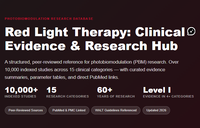
- Mito Red Research Evidence Hub — 10,000+ indexed PBM studies across 15 clinical categories.
- Wavelength reference — 633, 660, 810, and 830 nm comparison and dosing data.
- Independent third-party testing — spectrometer-verified output across the Mito Red product line.
- Mito Red Scientific Advisory Board — review workflow, evidence grading, primary-literature sourcing.
Mito Red Light products are general wellness devices. They are not medical devices and have not been evaluated, cleared, or approved by the FDA or any regulatory body for the diagnosis, treatment, cure, or prevention of any disease or medical condition. Any references to peer-reviewed research or clinical studies on this page describe findings from independent scientific literature and do not imply that Mito Red Light devices have been studied, tested, or proven effective for any specific condition. Always consult a qualified healthcare provider before beginning any new wellness routine, particularly if you have a medical condition or are taking medication.