











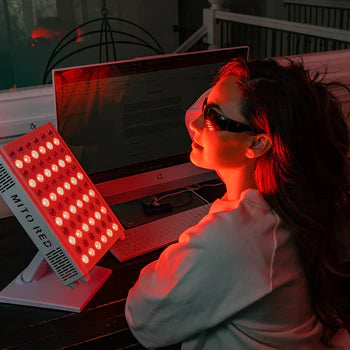


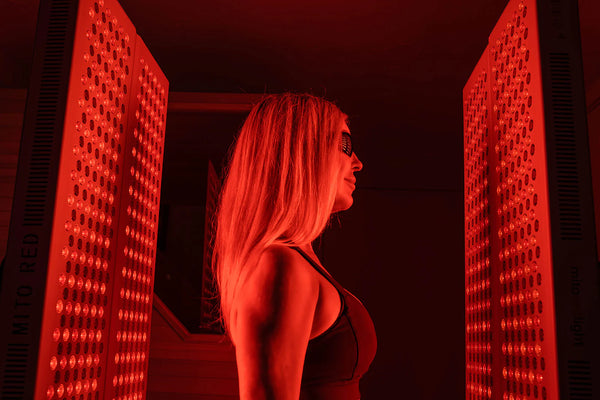
Panel Series
LED face masks deliver targeted red and near-infrared wavelengths directly to facial tissue, with peer-reviewed evidence for collagen production, acne reduction, and photorejuvenation. The MitoGLOW LED mask combines red, near-infrared, blue, and yellow wavelengths for full-spectrum facial photobiomodulation.
Red light therapy masks have moved from clinics to living rooms, and more people are using them every year. If you have sensitive skin, focus on safety: learn the basics, follow dosing guidelines, and look for FDA Class II device standards.
Clinical research shows that red light therapy presents minimal risk thanks to its non-UV spectrum, making it a great, non-invasive option for reactive skin types.
For sensitive skin, look for precise wavelengths (630-660 nm red, 800-850 nm near-infrared), adjustable intensity (irradiance), and FDA medical device clearance. Safety standards mandate consistent LED output and thermal management to prevent adverse reactions in reactive skin conditions.
How We Evaluated Device Safety and Efficacy
Our team at Mito Red Light ranks devices against proven photobiomodulation guidelines and FDA Class II standards. We focus on looking for steady irradiance, accurate wavelengths, and safe heat control — the basics that help sensitive skin stay comfortable.
Most light-therapy benefits show up with 4-12 weeks of steady use at the right wavelengths, so comfort and safety features matter. They make it easier to stick with treatment and see results.
Technical Evaluation Criteria
Our ranking framework focuses on evidence-based safety and efficacy parameters:
- FDA compliance and safety engineering : FDA Class II clearance, built-in safety protocols, contraindication documentation, and thermal management systems.
- Photobiomodulation specifications : Wavelength accuracy (±5 nm), irradiance uniformity (mW/cm²), LED quality standards, and spectral output consistency.
- Comfort engineering : Medical-grade materials, ergonomic design, adjustable irradiance, and session control systems.
- Clinical support and documentation : User protocols, contraindication guidance, and technical support resources.
Irradiance (mW/cm²) tells you how much light hits each square centimeter of skin. With adjustable output, you can start low and ease in if you’re light-sensitive. We also cover what matters most: eye safety, medication interactions, and step-by-step treatment plans.
FDA Class II Device Requirements
We established baseline technical standards for consumer photobiomodulation devices:
- FDA Class II medical device clearance ensures regulatory oversight and safety validation through 510(k) premarket notification processes.
- Ocular safety protocols require specific wavelength-appropriate eye protection guidance, particularly for individuals with photophobia or light sensitivity conditions.
- Wavelength verification and LED quality control prevent spectral drift and ensure consistent therapeutic output across device lifespan.
- Contraindication documentation protects users with photosensitizing medications, pregnancy, or active malignancy from inappropriate device use.
Red light therapy is generally well-tolerated when delivered through the right devices with the right wavelengths and irradiance controls. FDA Class II clearance is a key way to validate safety for home devices.
1. MitoGLOW Mask
The MitoGLOW™ is a battery-powered LED mask that brings clinic-style light therapy to your routine with five preset modes. It pairs targeted wavelengths (red 630 nm, blue 465 nm, amber 590 nm, and near-infrared 830 nm) to address common goals like smoothing the look of fine lines, calming redness, and managing breakouts.
A dense matrix of 1,064 LEDs delivers uniform coverage, and the rotatable chin/neck module extends treatment below the jawline. Built-in eye protection and a “hover over face” design keep sessions breathable and comfortable. The mask is FDA 510(k) cleared and designed for easy, wireless use at home or on the go.
How It Works
LEDs deliver gentle, non-UV light that your skin cells can use as a cue—red/near-infrared support collagen and recovery, amber helps calm visible redness, and blue targets acne-causing bacteria; the anti-acne mode also caps blue-light time at five minutes. Consistent use (a few sessions per week) is key.
LED therapy is noninvasive and generally well tolerated when used as directed, making it a good option for easily irritated complexions. Our mask’s no-touch fit reduces friction, and the integrated eye shielding adds comfort and safety.
Our research team provides individualized treatment protocols and safety guidance for sensitive skin applications. Access clinical protocols developed specifically for reactive skin conditions.
2. Omnilux Contour Face
The Omnilux Contour Face maintains FDA Class II clearance with established clinical safety data. This device offers standardized treatment protocols suitable for sensitive skin.
Medical-grade silicone construction provides a hypoallergenic contact surface with flexibility for facial contours. Fixed irradiance output delivers consistent 4.4 mW/cm² across the 633 nm wavelength spectrum. Clinical validation through peer-reviewed studies demonstrates safety in diverse skin phototypes.
3. CurrentBody LED Face Mask Series 2
CurrentBody's Series 2 device incorporates basic LED technology with consumer-focused design elements.
LED configuration utilizes red and near-infrared wavelengths with fixed irradiance output. Silicone construction provides basic comfort features for extended wear sessions, and timer controls offer session management with automatic shut-off functionality.
4. TheraFace by Therabody
TheraFace combines LED phototherapy with mechanical stimulation modalities, creating a hybrid treatment approach.
LED array delivers red and near-infrared wavelengths with integrated cooling elements.
Multi-modal design incorporates vibration therapy alongside photobiomodulation, and a modular approach allows selective activation of individual treatment modalities.
4. Solawave 4‑in‑1 Radiant Renewal Wand
Solawave's handheld device offers localized treatment capabilities for sensitive areas that require more conservative red light therapy.
Spot treatment capability allows for precise photon delivery to specific facial regions.
A conservative dosing approach supports gradual tolerance building for reactive skin conditions, and the portable design allows you to have controlled, localized sessions.
How To Approach Red Light Therapy for Sensitive Skin
Sensitive skin does best with gentle, evidence-based routines. Start low, go slow, and increase light exposure gradually while keeping an eye out for any irritation.
Patch Testing
Doing a patch test is one of the best ways to make sure your red light therapy device is safe for your specific needs:
- Step 1: Prepare your test site by gently cleansing and drying.
- Step 2: Apply the minimum device irradiance (typically 10 mW/cm²) for 30-60 seconds.
- Step 3: Monitor your test site for 24-48 hours, documenting any skin reactions.
- Step 4: If there’s no reaction after the patch test, proceed with your facial treatment.
Photo documentation can help you track both your response over time and any potential adverse reactions.
Progressive Treatment
It can be helpful to break down your treatment as follows:
- Initial phase (Weeks 1-2): Minimum irradiance, five-minute sessions, every other day frequency.
- Acclimation phase (Weeks 3-4): Gradual irradiance increase (2-5 mW/cm² increments) with extended session duration.
- Maintenance phase (Weeks 5+): Therapeutic irradiance levels with consistent session timing based on individual tolerance.
Keep an eye on your skin. If you see signs of inflammation, stop right away. Check with a clinician if you take photosensitizing meds or have a photosensitivity condition.
The Bottom Line
When you’re in the market for a red light therapy mask for sensitive skin, shop Mito Red Light for devices you can trust.
We design our devices with precise, lab-verified wavelengths, publish clear irradiance specs measured at real-world distances, and build with robust components for consistent output over time. Where applicable, we pursue FDA 510(k) clearance for specific indications and validate safety features like thermal management and built-in eye protection.
Every unit goes through quality checks before it ships, and we back it with responsive support, straightforward guides, and a solid warranty so you can enjoy some peace of mind. Shop our MitoGLOW™ LED Red Light Therapy Mask and work towards your dream skin.
Frequently Asked Questions
Are LED red light therapy masks safe for sensitive skin?
Yes, LED masks using non-UV red and near-infrared light are generally well tolerated when you choose medically engineered devices and follow dosing guidelines. Clinical research on sensitive skin shows good tolerability when wavelengths and irradiance are kept within photobiomodulation ranges, especially with FDA Class II devices that include eye safety, thermal management, and clear contraindication documentation.[web:172][web:173][web:175][web:181]
What wavelengths should I look for in a red light therapy mask?
For facial photobiomodulation, look for precise red wavelengths around 630–660 nm and near-infrared wavelengths around 800–850 nm, which are widely used in clinical anti-aging and sensitive-skin research.[web:175][web:177][web:180][web:182] The MitoGLOW™ mask also adds blue and amber/yellow light for acne support and visible redness, pairing 630 nm red, 465 nm blue, 590 nm amber, and 830 nm near-infrared LEDs for full-spectrum facial treatment.
Why does FDA Class II clearance matter for LED face masks?
FDA Class II 510(k) clearance means the device has undergone safety and performance review as a medical device, not just a cosmetic gadget. For LED masks, this helps ensure appropriate electrical and thermal safety, wavelength verification, consistent output, and formal guidance on eye protection and contraindications—key safeguards for reactive skin and photosensitive users.[web:173][web:175][web:181]
How should I start red light therapy if I have reactive or sensitive skin?
Start low and go slow: perform a patch test at minimum irradiance on a small area, monitor for 24–48 hours, then build up session length and intensity in small steps if no irritation occurs.[web:173][web:175][web:181] Many protocols begin with short sessions a few times per week and progress toward full-face schedules over several weeks, adjusting if you notice warmth, flushing, or delayed sensitivity.
How long does it take to see results from an LED face mask?
Most clinical studies on red light and LED masks report visible improvements in fine lines, texture, and clarity after 4–12 weeks of steady use, typically with multiple short sessions per week.[web:173][web:177][web:180][web:183] Because changes are driven by collagen remodeling and inflammatory balance, results accumulate gradually and depend on consistent use plus basics like sun protection.
Can LED masks help with acne and hyperpigmentation?
Yes. Blue light targets acne-causing bacteria at the surface, while red and near-infrared support healing and inflammation control, making multi-wavelength masks useful alongside standard acne care.[web:172][web:175][web:180][web:181] Red and NIR have also been studied for post-inflammatory hyperpigmentation and dark spots, with evidence that they can help fade discoloration over weeks by calming inflammation, supporting cell turnover, and modulating pigment pathways when paired with sun protection.[web:176][web:179][web:180][web:182][web:185]
What makes the MitoGLOW mask different from basic LED masks?
The MitoGLOW™ mask combines precisely tuned red, near-infrared, blue, and amber wavelengths with a dense LED matrix, adjustable modes, integrated eye shielding, and a hover-over-face fit for comfort and breathability. It is FDA 510(k) cleared as a Class II medical device, uses verified wavelengths and irradiance, and is supported by clinical protocols specifically developed for sensitive and reactive skin.[web:174][web:175][web:177][web:181]
This article discusses published scientific research and general educational information about photobiomodulation and red light therapy. It does not constitute medical advice and does not make specific claims about Mito Red Light devices. The research cited reflects independent peer-reviewed studies and does not imply that any Mito Red Light product has been evaluated, approved, or cleared by the FDA or any other regulatory body for the diagnosis, treatment, cure, or prevention of any disease or medical condition. Individual results vary. Consult a qualified healthcare professional before beginning any light therapy protocol, particularly if you have a pre-existing medical condition, are pregnant, or are taking photosensitising medications.
Mito Red Light products are general wellness devices. They are not medical devices and have not been evaluated, cleared, or approved by the FDA or any regulatory body for the diagnosis, treatment, cure, or prevention of any disease or medical condition. Any references to peer-reviewed research or clinical studies on this page describe findings from independent scientific literature and do not imply that Mito Red Light devices have been studied, tested, or proven effective for any specific condition. Always consult a qualified healthcare provider before beginning any new wellness routine, particularly if you have a medical condition or are taking medication.
Related articles
More from the skin health & anti-aging knowledge cluster