













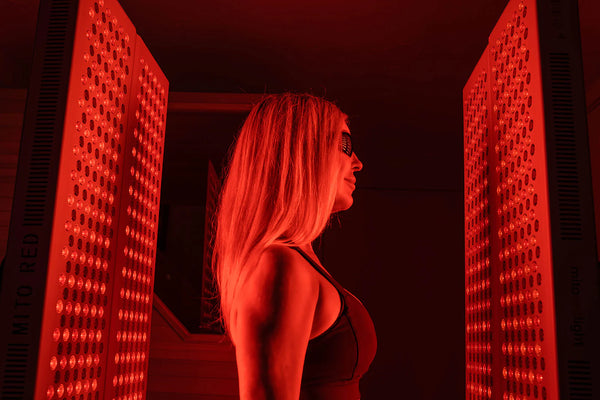
Panel Series
The 2026 Light Therapy Insiders Rankings Mostly Answer One Question: Which Panel Fills a 24 x 30 Inch Box?
Light Therapy Insiders recently published Best Red Light Therapy Panels of 2026: 11 Panels Put to the Test and a companion video. It ranks 11 panels across nine rounds. Our three panels finished sixth, seventh, and eighth.
The lab measurements behind the review are real. We use the same lab, LightLab International, and publish every report on our Independent Test Data page. The problem is what the scoring does with those measurements.
Strip away the nine rounds and this comparison mostly answers one question: which panel lights up a 24 x 30 inch box best? Half of the 100 points go to that question alone. On top of that, the review gets several facts wrong, including our prices and our amber light output.
The reviewer says he set the scoring system before seeing results, and we take him at his word. This is not about intent. It is about a scoring structure that tilts toward large panels no matter who builds it.
One quick note to avoid confusion: the MitoHacker 5.0, which led the rankings for eight rounds, is made by Mito Light, a separate European company. It is not a Mito Red Light product.
The short version
- Half the score answers one question: which panel lights up a 24 x 30 inch box best? Wider panels fill more of it, so they win three rounds at once.
- Our panels are 10 to 12 inches wide. They light about half the rectangle because of their shape, not because their light is weak.
- Put two of our panels side by side and the same design would jump from the bottom of those rounds to the top.
- The review said no panel delivered meaningful 590 nm amber light. Our MitoADAPT 4.0 measured 3.38 W, nearly 7 times the review's own cutoff.
- Output stability is the clearest test of build and component quality: steady output means the LEDs, cooling, and power electronics are doing their job. The MitoADAPT 4.0 ranked #1 of all 11 panels, losing less than 1% of its output over 20 minutes, and all three Mito Red Light panels scored 4.75 or higher out of 5. Yet this was the only round that measured anything close to build quality, and it was worth just 5 points!
- Two of our three delivered prices were listed $51 to $63 too high.
The Problem in One Picture: Pizza on a Tray
Imagine a pizza contest where the score is "how much of a 16-inch tray does the pizza cover?" A 12-inch pizza loses every time, no matter how good it tastes. Now add two more tests: "how much cheese is on the tray, on average?" and "how evenly is the tray covered?" The 12-inch pizza loses those too, because the empty edges of the tray count against it.
Put two 12-inch pizzas on the tray and suddenly they win all three tests. Nothing about the pizza changed. Only the amount of pizza did.
That is essentially how half of this ranking works.

Three Tests, One Rectangle, 50 Points
Rounds 1, 2, and 3 were all measured in the same 24 x 30 inch rectangle, 12 inches from the panel (Light Therapy Insiders):
| Round | What it asks | Points |
|---|---|---|
| 1. Coverage | How much of the rectangle gets strong light? | 35 |
| 2. Average irradiance | How much light lands in the rectangle, on average? | 5 |
| 3. Uniformity | How evenly is the rectangle lit? | 10 |
| Total | 50 of 100 |
These look like three separate tests. They are really three ways of asking one question: how much of this rectangle does your panel fill? A wide panel gets rewarded three times for the same thing.
The rectangle is also wider than most people. At 24 inches, it is wider than almost any adult's shoulders. Measured across the outside of the shoulders, the median U.S. man is about 20 inches wide and the median woman about 17.7 inches, and 95% of men are under 22.4 inches (NC State Ergonomics Center, ANSUR II data). So part of what a narrow panel "misses" is often space beside the person, not the person.
Our Panels Are Narrow by Design, Not Weak
Here is how much of the rectangle each panel sits directly in front of:
| Panel | Size | Share of the rectangle directly in front of the panel |
|---|---|---|
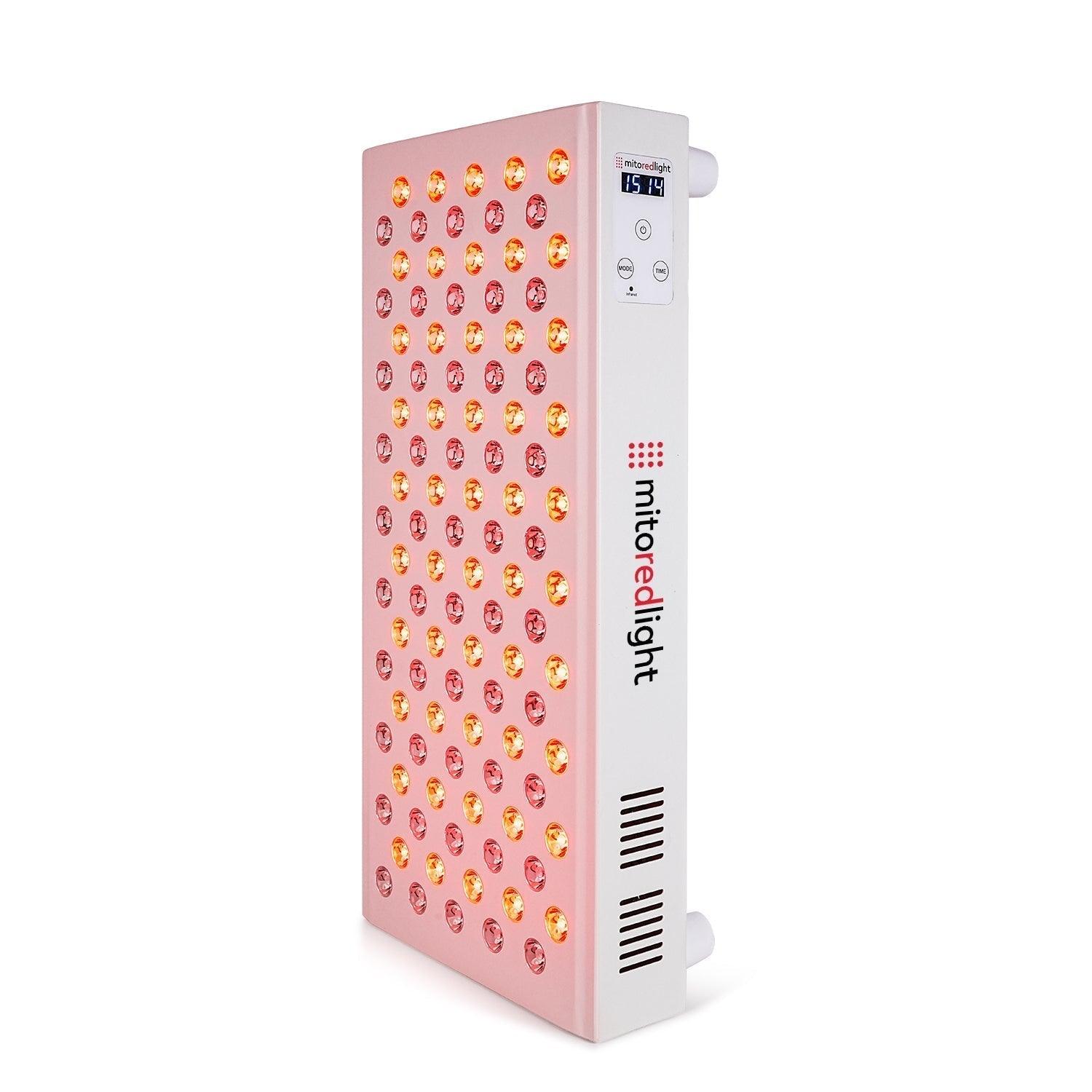
| MitoPRO 1500+ v2 | 36 x 12 in | 50% |
| MitoADAPT MAX 4.0 | 36 x 12 in | 50% |
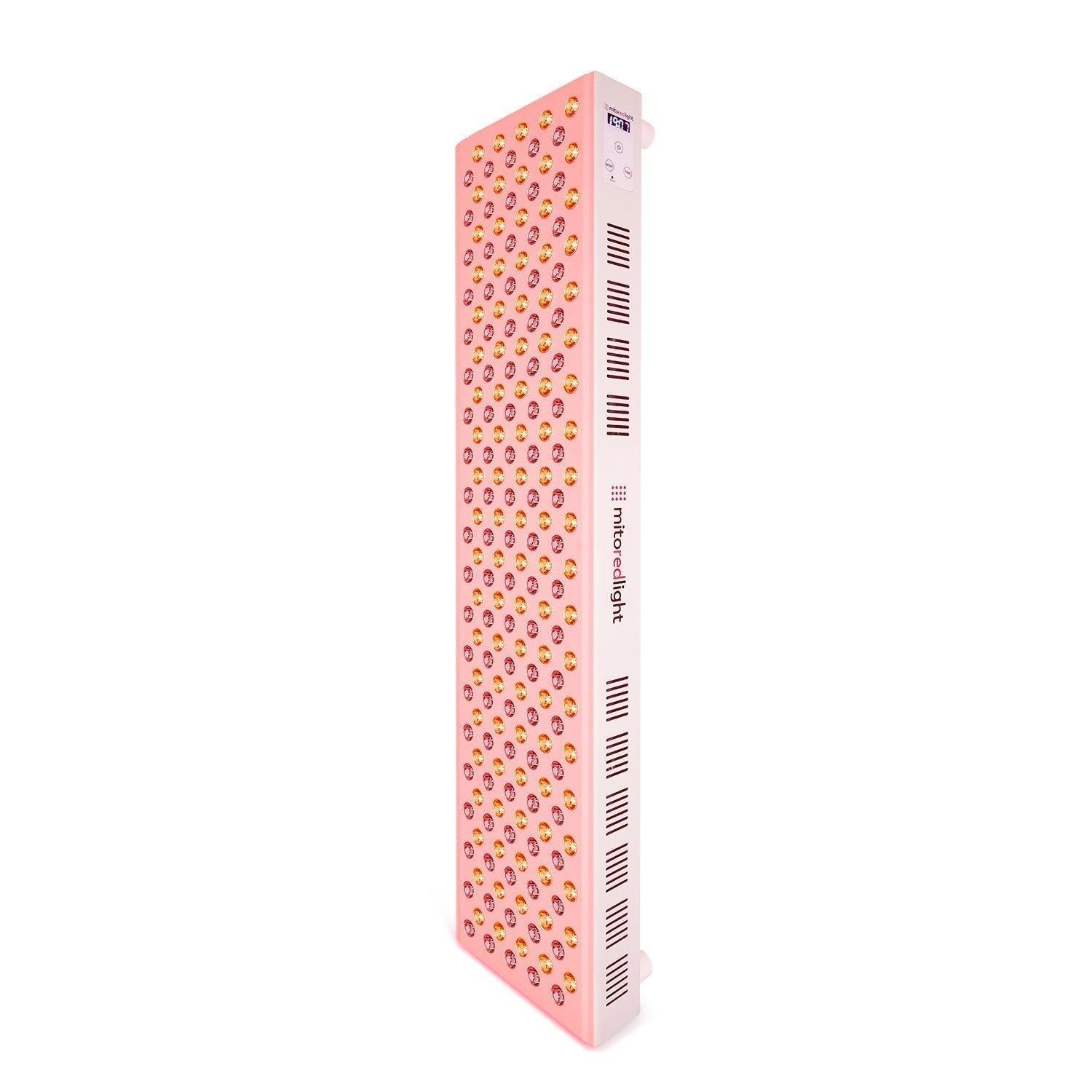
| MitoPRO 1500X | 43 x 10 in | 42% |
| MitoHacker 5.0 (Mito Light) | about 40 x 19.5 in (Light Therapy Insiders) | about 81% |
Light spreads a little past the edge of any panel, so these are not hard limits. But they show how the field is tilted before a single LED turns on.
Directly in front of our panels, the light is strong. LightLab measured 66.95 mW/cm² at the center of the MitoPRO 1500+ v2 at 12 inches, and 64.67 mW/cm² averaged across a face-size area. The review lists the same panel at 28.7 mW/cm².
"Average Irradiance" Is Really a Total-Wattage Score
Where does 28.7 come from? It is simply the total light that lands in the rectangle, divided by the size of the rectangle. LightLab measured 133.3 W of the MitoPRO 1500+ v2's light landing inside that 24 x 30 inch area. Divide by the area and you get exactly 28.7 mW/cm². The MitoADAPT 4.0 works the same way: 119.0 W in the rectangle, which gives 25.6.
Since the rectangle never changes size, this round is just "how many watts can you put into this box?" A wider panel with more LEDs puts in more watts. That is not a measure of how strong or well-dosed the light is where you stand. It is essentially a measure of how many LEDs are shining into the 24 x 30 inch box, and how much of their light fits inside it.
Most of our light already lands in the box: 87% for the MitoPRO 1500+ v2 and 83% for the MitoADAPT 4.0. The low "average" comes from the size of the box, not from wasted light.
The Tallest Panel Got Punished for Being Tall
The MitoPRO 1500X actually puts out the most light of our three panels: 161.1 W, according to LightLab. Yet it received the lowest average irradiance score of the three.
Why? The rectangle is 30 inches tall and the 1500X is 43 inches tall. The top and bottom of the panel shine outside the box and are never counted, so only 74% of its light makes it into the measurement. Extra height covers more of a standing person in real life. In this scoring system, it counts against you.

Put two 1500X panels side by side and you get a 20 x 43 inch light source: 860 square inches, more than the MitoHacker's roughly 780. They would sit in front of 83% of the box, more than the MitoHacker's 81%, and still have 13 inches of length the box never sees. Same panels, same light. The only thing that changed is how well the shape fits the box.

The Two-Panel Test
The clearest way to show a size bias is to change the size and nothing else. Using LightLab's measured light map for one MitoPRO 1500+ v2, we estimated what two of them side by side would score in the same rectangle:
| Round | One MitoPRO 1500+ v2 (review) | Two side by side (our estimate) | MitoHacker 5.0 (review) |
|---|---|---|---|
| Coverage | 42.2% | about 85% | 75.5% |
| Average irradiance | 28.7 mW/cm² | about 55 mW/cm² | 54.8 mW/cm² |
| Uniformity | about 40% | about 70% | 68.1% |
Why not 100% coverage, when two panels fill the whole box? Coverage counts only the parts of the box receiving at least 30 mW/cm². Light naturally fades at the outer edges of any panel, so the outermost strip of the box falls below that line. Everything else, including the seam between the two panels, clears it. Our estimate is conservative: LightLab's own calculation method scores a single panel slightly higher than our simple point count does.
Of course two panels deliver more total light than one. That is exactly the point. The same LED design, the same optics, and the same light per square inch go from the bottom of these rounds to the top, simply because there is more panel. If a test can be won by buying more of the same thing, it is measuring quantity, not quality.
Two MitoPRO 1500+ v2 panels cost about 14% more than the review's delivered price for the MitoHacker ($2,404 vs $2,114, using the review's own pricing method). They also give you something one large panel cannot: you can split them up for different body areas or mount them for full-body coverage.
The review itself concedes the size effect. Describing the MitoHacker, it says: "It's enormous!" and "That extra size helps it deliver useful light intensity across a much larger treatment area" (Light Therapy Insiders). Size can be a legitimate preference. But when size drives 50 of 100 points and price only 10, the ranking stops answering "which panel is best?" and starts answering "which panel is biggest?"
The Only Real Build-Quality Test Was Worth Only 5 Points!
Size decided half the score. So what did the review give to the one thing that tells you how well a panel is built? The only round that actually measured anything close to build or component quality was worth 5 points out of 100.
That round was Round 4, output stability. The review measured each panel's light output when it was switched on and again after 20 minutes (Light Therapy Insiders). Round 8 scores ownership extras like warranties, certifications, return policies, expansion options, and noise. Those matter, but none of them measures how well a panel's LEDs, cooling, and power electronics are built.
Why stability tells you how a panel is built
LEDs lose output as they heat up. Engineers call this "thermal droop," and the U.S. Department of Energy notes that red and amber LEDs, the kind used in red light therapy panels, experience the greatest thermal droop of any common LED type (U.S. Department of Energy).
That makes stability a window into everything you cannot see from the outside: how good the heat sinks are, how well the fans move air, how well the drivers regulate power, how hard the LEDs are being pushed, and the quality of the LEDs themselves. When output holds steady, all of that is working. When output sags, the LEDs are running hotter than they should.
What the 20-minute test showed
| Panel | Output still there after 20 minutes | Stability points (of 5) |
|---|---|---|
| MitoADAPT MAX 4.0 | 99.3%, best of all 11 panels | 5 |
| MitoPRO 1500+ v2 | 97.4% | 5 |
| MitoPRO 1500X | 94.2% | 4.75 |
| MitoHacker 5.0 (Mito Light) | 86.6%, worst of all 11 panels | 2.25 |

The panel that led the rankings for eight of nine rounds lost 13.4% of its output in a single 20-minute session. That is nearly 17 times the MitoADAPT 4.0's drop. For the person using it, the light at the end of the session is noticeably weaker than the light at the start.
Can you trust an irradiance number from a panel that drifts?
An irradiance number is a snapshot. For a stable panel, the snapshot describes the whole session, because the output barely moves. For a panel that loses 13.4% in 20 minutes, the number depends on when you take it. A reading taken right after switching on can be well above what the panel delivers by the end of a session.
For our panels, LightLab states that each one "was allowed to reach stabilization according to IES LM-79-24 criteria prior to measurements," so our coverage and irradiance figures reflect warmed-up, steady output. The review does not say whether every panel's coverage and irradiance data was measured the same way. It should, because for a panel that drifts this much, timing alone changes the result. The same caution applies to any brand spec sheet or quick handheld reading taken shortly after a panel is turned on.
These were brand-new panels
Every panel in the comparison was tested new. Research on red LEDs identifies rising junction temperature as "the primary cause" of lost output, reduced reliability, and shorter LED lifetime (Solid-State Electronics). One 20-minute test of a new panel cannot predict how it will perform in year three. But a panel that runs hot enough to lose 13.4% of its output in its first session raises a fair question about how it will hold up over thousands of sessions. That is exactly why stability deserved far more weight than it got.
How little it counted
Worst-in-class stability cost the MitoHacker 2.75 points. On coverage alone, being about 8 inches wider than the MitoADAPT 4.0 earned it 15.5 more points. In this scoring system, fitting the box is worth more than five times as much as keeping your output steady.
That says everything about what the ranking values. The one test that reflects how a panel is built barely moves the score. The test that reflects how big the panel is decides it.
The 590 nm Amber Claim Is Wrong
The review set a rule that each wavelength must deliver at least 0.5 W to count. It then said "not a single panel met the minimum power threshold for 590 nm" (Light Therapy Insiders).
LightLab measured the MitoADAPT 4.0 at 3.38 W in the amber band (570 to 600 nm), with a clear amber peak. That is nearly 7 times the review's own cutoff, measured in the mode where all eight wavelengths run together. For comparison, the MitoPRO 1500+ v2, which has no amber LEDs, shows only 0.20 W in that same band. So more than 3 W of the MitoADAPT's reading is genuine amber light.
Amber LEDs make up one in eight of the MitoADAPT's chips, and they are intentionally run at lower power than the red and near-infrared LEDs. Amber is meant to complement red light, not dominate the spectrum. When you want more of it, some of the MitoADAPT's 11 modes turn off other red wavelengths so amber makes up a larger share of the active light.
The 0.5 W cutoff has its own size problem, too. It is a fixed total, so a bigger panel with more LEDs clears it more easily than a smaller one with the same design. Once again, the rule favors size.
Our Prices Were Wrong
The review says it used discounted prices "using available codes and links, including shipping and applicable taxes," delivered to Austin, Texas. Its own 5% MitoRed Light discount link works sitewide, and we ship free in the U.S. Applying that method correctly:
| Panel | Review's price | Correct price by the review's method | What went wrong |
|---|---|---|---|
| MitoPRO 1500+ v2 | $1,265 | $1,202 | 5% discount not applied |
| MitoPRO 1500X | $1,335 | $1,284 | Based on a price the panel has not been listed at |
| MitoADAPT MAX 4.0 | $1,541 | $1,541 | Correct |
Our three panels finished within 1.5 points of each other, and the MitoPRO 1500+ v2 finished just 0.25 points out of fifth place. In a race that close, getting the price right matters.
The Logical End Point: A Panel Built to Win the Box
Follow this scoring system to its conclusion and you can design the winner on paper. Make a panel exactly 24 x 30 inches so it fills the whole box. Load it with as many listed wavelengths as possible, since each one only has to clear a fixed 0.5 W. Add presets named "Sleep," "Recovery," and "Skin." Use the cheapest components you can to win the price round.

That panel would collect top marks in the rounds worth the most points. None of what makes a panel good to own would matter much: how strong the light is where you stand, how evenly each wavelength is spread, how much control you have over the spectrum, or whether the output holds steady through a session. A ranking that would crown a panel like that is not measuring quality. It is measuring fit to a box.
Other Inconsistencies
- LED layout earned bonus points for some brands, not others. Two competitors received 3 bonus points each for LED layout and design features. The MitoADAPT 4.0's LED layout, which is patent pending (the USPTO issued a Notice of Allowance in September 2026, U.S. Application No. 18/578,304), received none. Its layout spreads every wavelength evenly across the panel, so each of its 11 modes delivers evenly distributed light.
- The most configurable panel got the lowest customization score. The MitoADAPT 4.0 has eight wavelengths on eight separate circuits and 11 selectable combinations. It received 1 of 3 customization points, the lowest in the table (Round 7 table, video at 18:16).
- Points for preset labels, not light. Panels earned points for presets named things like "recovery" or "skin health." No one has established which preset is best for those goals. Those points reward software menus, not the light a panel delivers.
- Dual-chip LEDs got no credit. The site's own methodology page says it assesses "whether panels use modern multi-chip LEDs to blend output" (Light Therapy Insiders). This comparison did not.
What a Fair Comparison Would Do
- Measure the light where you stand, not averaged across a rectangle wider than your body.
- Compare equal budgets. If one large panel costs about the same as two smaller ones, test both setups.
- Count size once, not three times.
- Use wavelength rules that do not depend on panel size, like a share of total output instead of a fixed number of watts.
- Apply bonus points and discounts the same way to every brand.
The Bottom Line
At its core, this ranking judges which panel lights up a 24 x 30 inch box best. That one question is worth half the points, and wider panels answer it more easily. Put two of our panels side by side and the same design wins those rounds, which shows they were measuring size, not light quality. The review also missed 3.38 W of amber light and listed two of our prices too high.
If you are choosing a panel, ask four questions: how strong is the light where I will stand, how evenly is each wavelength spread, how much control do I have over the spectrum, and what am I paying for the light I get? Our red light therapy buyer's guide walks through each one, and every LightLab report for our panels is on our Independent Test Data page. You can also compare the full Mito Red Light panel lineup or read how the MitoADAPT lets you tailor the spectrum.
Why We Respond to Reviews Like This
Alex Fergus has spent years reviewing red light therapy panels, and his comparisons reach a large audience. That is exactly why the method matters. When a widely watched ranking rewards size over engineering, many buyers walk away believing the biggest panel is the best panel.
We welcome the chance to respond, because every comparison like this is a chance to explain how red light therapy panels actually work: how light is measured, why the testing window matters, what stability tells you about build quality, and why the number of wavelengths on a spec sheet matters less than how evenly and reliably each one is delivered. We design our panels around those principles, test them with independent labs, and publish every report on our Independent Test Data page so anyone can check our work.
We would be glad to see a future comparison that measures light where people actually stand, accounts for panel size and price, and weighs build quality the way it deserves. Until then, we will keep doing what we have always done: explaining the details, showing our data, and helping buyers understand what really makes a panel good.
Frequently Asked Questions
Why did bigger panels score higher in the 2026 Light Therapy Insiders rankings?
Three rounds worth 50 of 100 points were measured in the same 24 x 30 inch rectangle. Wider panels fill more of that rectangle, so they score higher on all three at once.
Why was the MitoPRO 1500+ v2 listed at 28.7 mW/cm²?
That figure is the total light landing in the 24 x 30 inch rectangle divided by the rectangle's area. Directly in front of the panel, LightLab measured 66.95 mW/cm² at the center and 64.67 mW/cm² across a face-size area at 12 inches.
Does the MitoADAPT 4.0 deliver meaningful 590 nm amber light?
Yes. LightLab measured 3.38 W in the amber band in its all-wavelength mode, nearly 7 times the review's 0.5 W cutoff.
Is the MitoHacker 5.0 a Mito Red Light product?
No. The MitoHacker 5.0 is made by Mito Light, a separate European company.
Where can I see Mito Red Light's lab results?
Every LightLab International report for our panels is on the Independent Test Data page.
Appendix: The Technical Details
Coverage scoring. The published coverage scores fit a straight line: about 0.435 points per percentage point of coverage, minus 8.6, accurate to within about a quarter point for every published score. At that rate, a panel needs roughly 20% coverage just to score above zero.
Average irradiance math. The rectangle is 24 x 30 inches, or about 4,645 cm². LightLab measured 133.3 W landing in it from the MitoPRO 1500+ v2 (of 153.7 W total), 119.0 W from the MitoADAPT 4.0 (of 143.0 W), and 119.0 W from the MitoPRO 1500X (of 161.1 W). Dividing each by 4,645 cm² reproduces the review's figures.
Uniformity. The review's uniformity figures are consistent with average irradiance divided by peak irradiance across the rectangle. That measure penalizes narrow panels, whose edges fall off within the rectangle, and panels with a strong center.
Two-panel estimate. We added two copies of the MitoPRO 1500+ v2's measured LightLab light map, 12 inches apart, and scored the result in the same rectangle. This is an estimate from measured data, not a separate lab test, and it ignores any mounting gap between the panels.
Wavelength counting. LightLab's spectra show the 830 nm and 850 nm LEDs overlapping into a single peak, so a spectrometer cannot cleanly split watts between them. The MitoADAPT 4.0 and MitoPRO 1500X contain all five of the review's "core" wavelengths, yet scored the same 4 of 5 as the MitoPRO 1500+ v2, which has no 810 nm LEDs. The review does not explain how overlapping peaks were separated.
MitoADAPT 4.0 layout. Every LED pairs one near-infrared chip with one red or amber chip. Near-infrared wavelengths rotate through 850, 810, 940, and 830 nm in a repeating four-row pattern, and red wavelengths alternate column by column. Each of the eight wavelengths occupies 12.5% of the chips and repeats across the entire panel.
Sources
- Light Therapy Insiders, Best Red Light Therapy Panels of 2026: 11 Panels Put to the Test, November 2026.
- Alex Fergus, Best Red Light Therapy Panels of 2026: 11 Panels Tested (video), November 2026.
- Light Therapy Insiders, Correct vs. Incorrect Review Methodology.
- Light Therapy Insiders, MitoHacker 5.0 Review (panel dimensions).
- LightLab International Allentown, reports LLIA003081-001 (MitoADAPT MAX 4.0), LLIA003081-002 (MitoPRO 1500+ v2), and LLIA003081-003 (MitoPRO 1500X), September 2026, on the Mito Red Light Independent Test Data page.
- U.S. Department of Energy, 2019 Solid-State Lighting R&D Opportunities (thermal droop).
- Thermal measurements and analysis of AlGaInP/GaInP MQW red LEDs, Solid-State Electronics.
- The Ergonomics Center, NC State University, Anthropometric Data for U.S. Adults (ANSUR II, Gordon et al. 2014).
- U.S. Patent and Trademark Office, Notice of Allowance, U.S. Application No. 18/578,304, mailed September 28, 2026.
Dive deeper into the research
- Mito Red Research Evidence Hub — 10,000+ indexed PBM studies across 15 clinical categories.
- Wavelength reference — 633, 660, 810, and 830 nm comparison and dosing data.
- Independent third-party testing — spectrometer-verified output across the Mito Red product line.
- Mito Red Scientific Advisory Board — review workflow, evidence grading, primary-literature sourcing.
Mito Red Light products are general wellness devices. They are not medical devices and have not been evaluated, cleared, or approved by the FDA or any regulatory body for the diagnosis, treatment, cure, or prevention of any disease or medical condition. Any references to peer-reviewed research or clinical studies on this page describe findings from independent scientific literature and do not imply that Mito Red Light devices have been studied, tested, or proven effective for any specific condition. Always consult a qualified healthcare provider before beginning any new wellness routine, particularly if you have a medical condition or are taking medication.